Skincare Discovery Kit OEM: Test Mini-Pack Delivery and Consumer Instructions
Plan a skincare discovery kit OEM project with mini-pack priming, usable-content checks, clear directions and consistent sample-to-full-size experience.
Direct answer
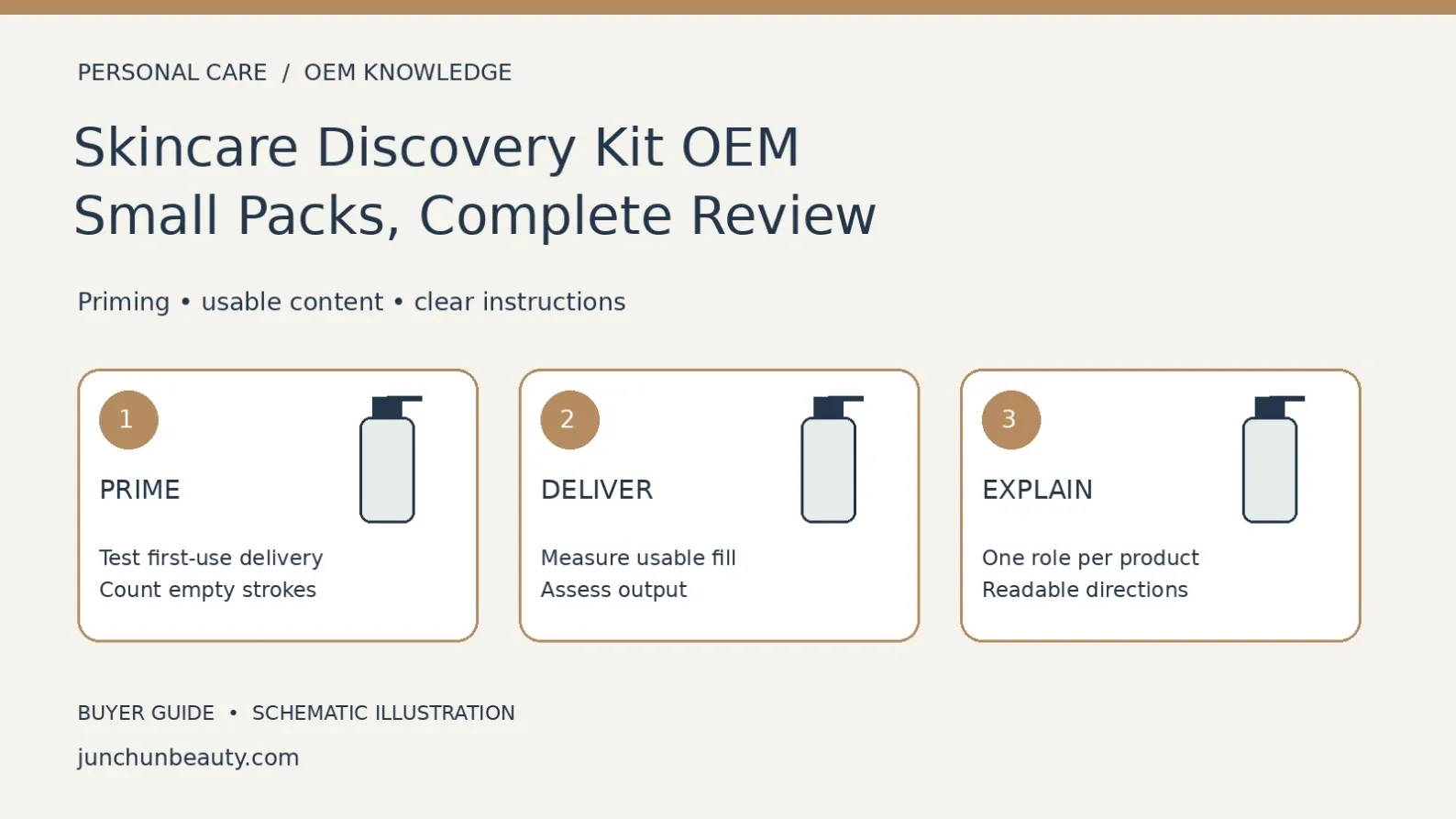
Treat a skincare discovery kit as a separate packaging and user-experience project, even when it uses existing formulas. Verify first-use delivery, usable content, compatibility and readable directions for each mini component. Keep the routine focused and preserve the sample-to-full-size experience. A smaller package does not automatically inherit the full-size pack's dispensing or stability approval.
Why discovery formats deserve a sourcing review
M&S and Sephora's 29 September 2026 partnership announcement describes a specialist beauty offer spanning skincare, hair care and body care, with a planned spring 2027 launch. It supports a retail-discovery discussion but does not establish acceptance of any supplier's trial kit. Source: M&S corporate release, 29 September 2026.
Our inference is that a clear discovery format can help buyers evaluate a concise range. Its usefulness depends on reliable delivery, understandable instructions and the right assortment rather than the number of miniature products.
Assign a distinct role to each product
A cleanser, treatment serum and moisturizer can form a straightforward routine if the approved products are intended to be used together. An additional mist may fit another use case, but do not add it simply to fill a carton.
Avoid selecting three products with the same vague radiance message. Write the application area, amount, sequence and use frequency for each. If instructions become complicated, simplify the assortment.
Choose a realistic trial duration
Estimate potential uses from proposed fill and actual dose. Distinguish total net content from content the consumer can practically dispense.
A small kit may support assessment of texture and application. Do not promise that a short trial establishes every long-term skincare effect. Claim duration and trial duration are separate decisions.
Test mini-pack delivery
| Check | What to record | Why buyers need it |
|---|---|---|
| Priming | Strokes before reliable delivery | First-use usability |
| Output | Mass per stroke and variability | Practical directions and dose |
| Recovery | Behavior across normal intervals | Routine consistency |
| End-of-use | Undispensed residue and access | Usable-content planning |
| Closure | Leakage and handling | Transport and consumer experience |
Agree the number of components and storage conditions with the packaging team. This is a purchasing framework, not a universal standard or an established pass threshold.
Test the actual mini component and approved fill. A demonstration assembled with a substitute pump cannot validate the intended production pack.
Preserve consistency with the full-size product
Record the formula version, filling process and relevant release specifications. Compare sensory experience from mini and full-size packs after dispensing, using the same application amount.
Packaging can create a different user impression through output, handling or exposure during use. Investigate differences rather than assuming the formula has changed. Ask the lab to determine whether additional compatibility or stability work is needed.
For a face mist, spray distance and application area should follow the approved instructions. A mini sprayer that feels concentrated or uneven needs review before it is placed in the kit.
Build hygiene and safety into the intended use
Review repeated opening, product access and typical handling for jars or tubes. Where a tester is shared in retail, design a separate controlled-use arrangement instead of using a consumer mini indiscriminately.
Have qualified reviewers determine the relevant safety and microbiological requirements. Avoid automatic claims such as hypoallergenic, non-comedogenic or dermatologist approved. These require appropriate support for the specific product.
Keep essential directions readable
Mini packs have limited label area. Confirm which information belongs on the component and which can be supplied on accompanying materials under the destination-market review.
Use a simple sequence card that explains amount, placement, frequency and relevant cautions. Supplemental digital instructions can help education, but should not be assumed to replace mandatory on-pack information.
Test comprehension with users who have not seen the development brief. Ask them to explain the routine back in their own words. Record confusion rather than correcting every participant before measurement.
Compare the kit's economics
Quote filling, small components, decoration, cartons, assembly, compatibility work and freight. A lower fill volume does not necessarily mean a proportionately lower cost.
Review the hydrating face-mist capability and skincare product range. Selected mature formulas with stock packaging may support smaller projects, but each mini component's availability and MOQ must be confirmed.
Buyer FAQ
Can the full-size stability approval cover every mini pack?
Not automatically. Ask the laboratory to review component and use differences.
Is net content the same as usable content?
No. Net fill and the amount practically dispensed are different measures.
Does a discovery kit guarantee full-size conversion?
No. Measure actual trial experience and subsequent purchase rather than assuming conversion.
Should a mini kit contain as many products as possible?
No. Distinct roles, simple instructions and reliable delivery are more useful than unnecessary complexity.
Project discussion
Send your proposed routine, trial objective, mini sizes, full-size references, quantities and target markets through Contact. Request a formula-and-mini-pack review before setting the kit price or launch date.