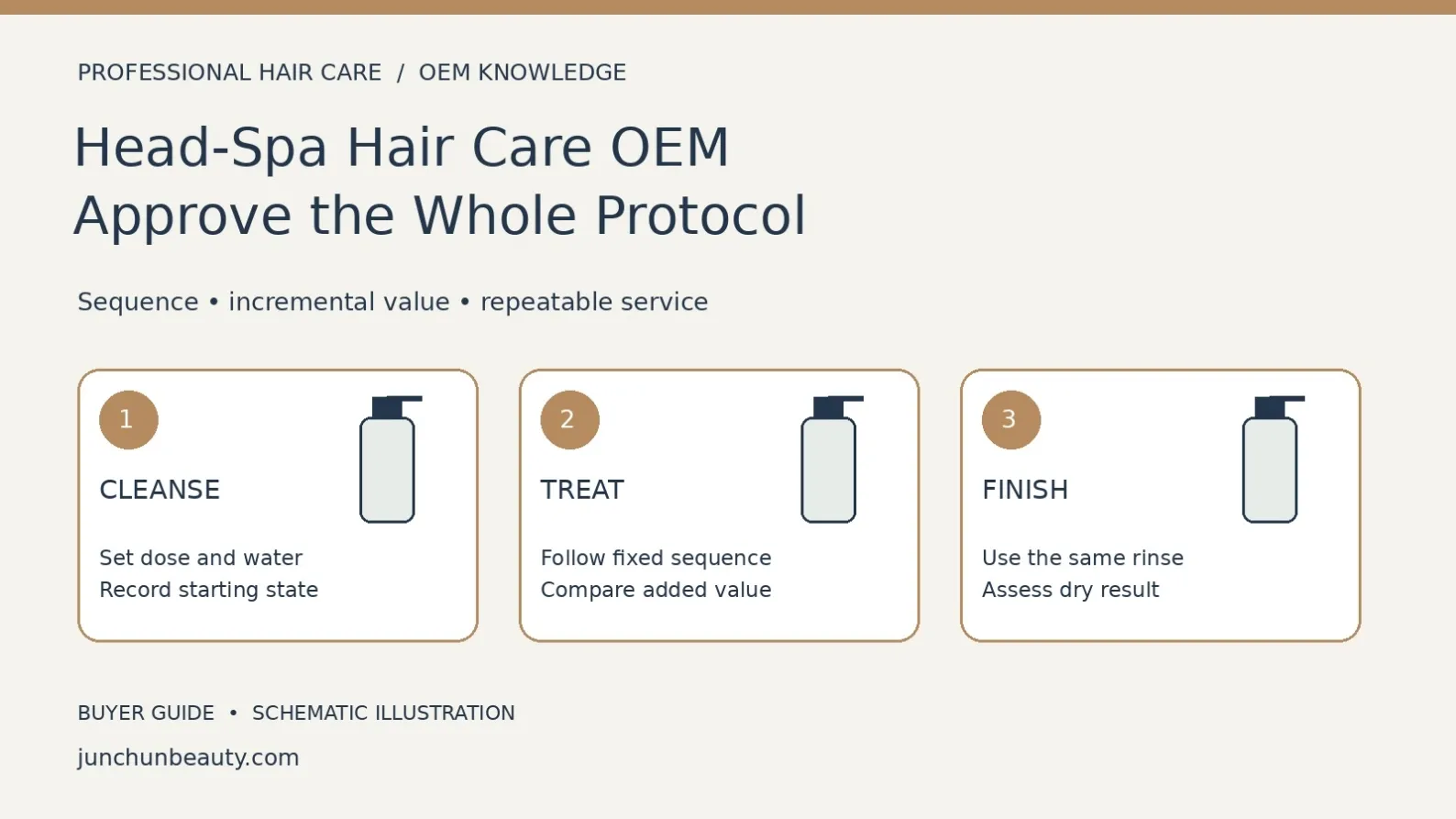
Head-Spa Hair Care OEM: Test the Complete Protocol Before Approving Each SKU
Evaluate a head-spa hair-care OEM routine by testing the full sequence, each SKU's added value, rinse behavior and practical salon-to-home directions.
Direct answer
Approve a head-spa hair-care system by testing the complete sequence and the incremental value of its individual steps. Fix application dose, contact time, rinsing and drying before comparing routines. A cleanser, serum and mask that perform well separately may not justify a three-step service together. Use the results to simplify the protocol and align salon and home-use instructions.
The recent product signal
John Masters Organics' September 2026 launch announcement connects a cream cleanser, serum and mask in a head-spa-inspired routine. This establishes a specific brand direction. It does not validate another routine or prove demand for extra treatment steps. Source: John Masters Organics Group, 29 September 2026.
Our inference for professional buyers is to evaluate the sequence as a service. A premium label is easier to explain when every step has a documented role and the user can repeat the application.
Define service conditions before sampling
Specify the intended salon time, water conditions, hair density, scalp application area, rinse stages and expected home-care continuation. Identify whether a product is rinse-off or leave-on. Do not leave that distinction to a presenter or stylist.
Record common styling residue and chemical-treatment history for the target customers. If a service is intended for heavily styled hair, a lightly soiled sample may not represent it.
Separate scalp and hair-fiber observations
Use appropriate scalp-tolerance and consumer-feel assessments under professional guidance when required. Evaluate hair-fiber performance separately. A hair tress does not prove scalp comfort, and a pleasant scalp sensation does not establish fiber repair.
Do not use massage, steam or heat to imply medicinal treatment. Include any equipment in the approved protocol and assess its use conditions rather than adding it casually during a demo.
Compare complete and reduced routines
| Routine | Procurement question | What to hold constant |
|---|---|---|
| Cleanser plus mask | What is the core wash-and-treatment experience? | Hair preparation, dose and rinse |
| Cleanser plus serum plus mask | Does the serum add a useful result? | Same core products and timings |
| Approved routine plus home finish | Is the final step useful without excess residue? | Drying method and application area |
This is a suggested development comparison. The laboratory should choose a design and number of replicates suitable for the question. For consumer-use testing, plan how routines are assigned and how prior-product effects are controlled.
If the additional serum improves only fragrance preference, describe that honestly. Do not market an unmeasured repair contribution. If the extra step adds time without meaningful benefit, a two-step system may be the better commercial route.
Test interactions as observed risks
Assess whether each layer spreads evenly, becomes difficult to rinse, changes pickup from the next product or leaves an undesirable dry finish. These are questions to investigate, not assumed defects.
Record separate ratings for wet slip, rinse effort, root appearance, end feel and movement. A single overall “luxury” score may conceal a routine that feels excellent wet but disappointing after drying.
Use blind-coded samples where possible. Ask stylists to record deviations from the protocol so that personal technique is not mistaken for formula performance.
Build approval criteria around the service
Agree the acceptable treatment time, rinse effort, dispensing behavior and final finish before approving a production sample. Project-specific criteria should reflect the consumer and channel; do not borrow universal pass limits from an unrelated product.
Then repeat the selected protocol using the intended packs. Large salon pumps, retail pumps and jars can alter practical dosing even when the formula is coordinated.
Translate the salon protocol into home instructions
Reduce the steps to what consumers can follow safely and consistently. Define amount, placement, waiting time, rinsing and frequency. A stylist-controlled service does not automatically support the same directions at home.
Give each product a clear label role. Avoid using “scalp treatment” on a product approved only for lengths. Make supplementary fragrance or sensory effects distinct from tested performance claims.
Review professional hair-care capabilities and the fruity hair-care collection for coordinated format options. Exact formula, pack, testing scope and MOQ remain project-specific.
Buyer FAQ
Should a head-spa range always have three steps?
No. Keep a step only when it has a useful, documented role in the intended routine.
Can a tress test establish scalp benefits?
No. Hair-fiber and scalp assessments answer different questions.
Can salon and retail products share a formula?
Potentially, but pack compatibility, dosing, directions and capacities still require review.
Does a premium botanical story prove better performance?
No. Evaluate the finished routine and substantiate the claims you intend to publish.
Project discussion
Send your proposed service steps, target users, available treatment time, salon and retail sizes, quantities and markets through Contact. Request a protocol-based sample plan before approving a broad collection.