Hair Strand Serum OEM: Build a Breakage, Frizz and Heat-Protection Test Matrix
Build a hair strand serum OEM test matrix with defined comparators, doses and methods for breakage, frizz and heat-protection claims before approval.
Direct answer
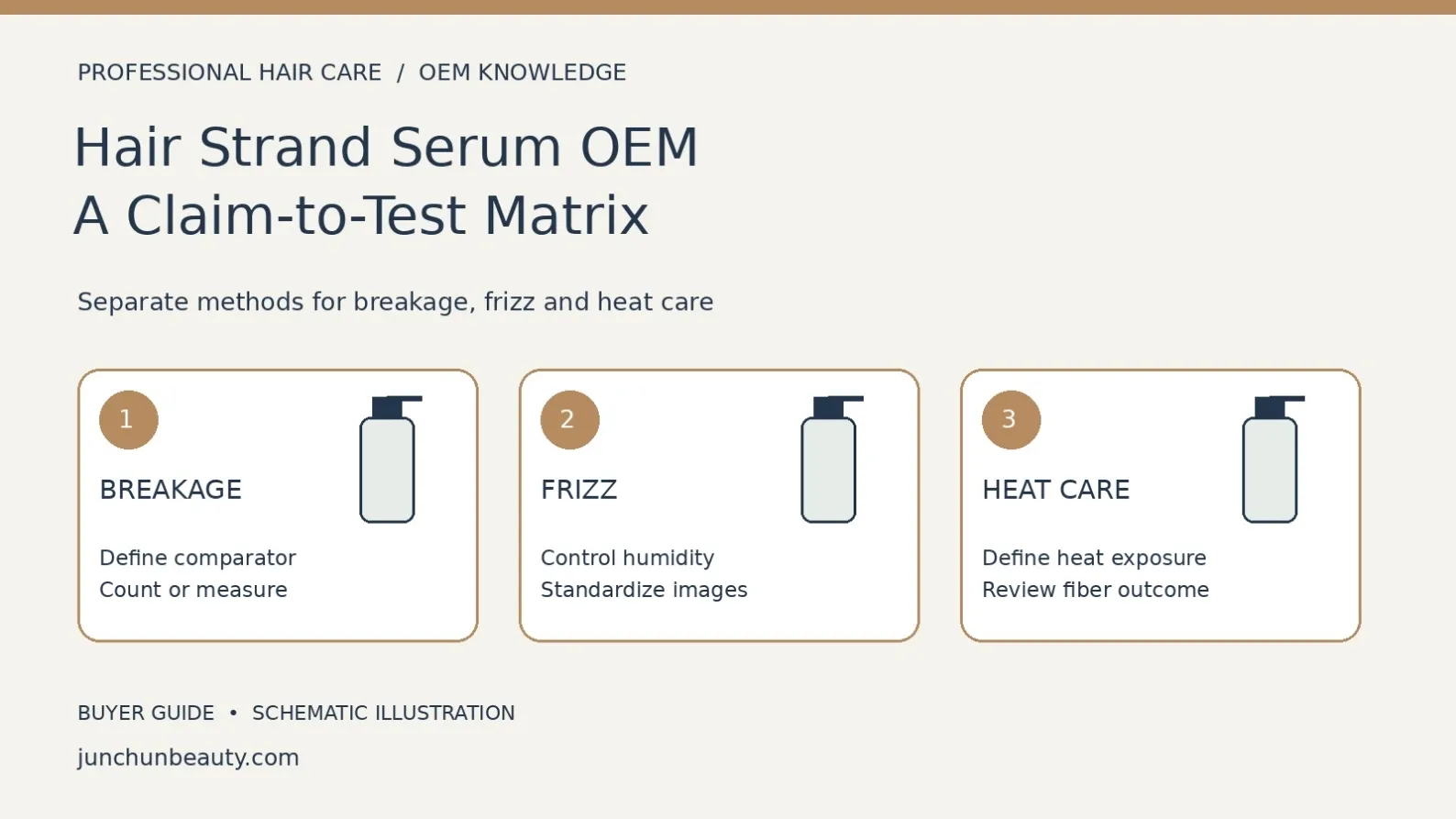
Build a separate evidence plan for each strand-serum claim. Define target hair condition, comparator, product dose, application routine, measurement and reporting before commissioning tests. Breakage reduction, frizz control and heat protection are different outcomes; success in one does not establish the others. Ask the OEM supplier to price the formula, packaging and claim-support scope together.
A recent launch raises the evidence question
Nutrafol announced Strand Serum on 30 September 2026 and published conditions behind several quantified claims. This is the brand's reported finished-product evidence; its figures cannot be transferred to a similar ingredient list or another supplier's serum. Source: Nutrafol release, 30 September 2026.
Our buyer inference is that a useful serum brief should state exactly which performance questions the proposed testing will answer. “Strong hair” is too broad to quote reliably without further definition.
Separate strand care from scalp care
A strand serum can be designed around lengths and ends, surface feel, manageability and resistance to the tested styling stress. A scalp product requires a different application brief and safety review.
Do not allow a length-retention concept to imply faster follicular growth. Less measured breakage in a defined method does not establish treatment of shedding or a medical hair-loss condition.
Create the matrix before selecting headline percentages
| Claim territory | Protocol questions | Appropriate limitation |
|---|---|---|
| Breakage reduction | What stress, hair type, dose and control are used? | Result applies to the tested method and conditions |
| Frizz control | What humidity, timing, image method and starting state? | Immediate control is different from long-duration control |
| Heat protection | What tool, temperature, passes and fiber endpoint? | A shiny finish does not prove protection |
Ask the lab which methods are fit for the proposed wording. Internal selection screens and formal claim substantiation have different purposes. A favorable salon comment is useful product feedback, but it is not a numerical instrumental result.
Specify the breakage endpoint
Broken-fiber counting, combing force and tensile behavior answer different questions. Choose the endpoint that matches the wording, and retain raw observations and the report's limitations.
If a study reports percentage reduction, the calculation must identify the control. For a count-based endpoint, a common calculation is: reduction = (control count − treated count) / control count × 100. This calculation is meaningful only when counts come from comparable samples and the control is nonzero. It does not correct a weak study design.
Standardize frizz imaging
Define hair preparation, orientation, background, humidity exposure and image timing. Agree an analysis method before reviewing the images. A controlled image may support the specified appearance outcome, while a casual before-and-after photograph should not become a durability claim.
Describe heat exposure completely
Record the styling tool, setting, actual exposure conditions where measurable, pass count, drying state and product application. Ask the laboratory to justify the damage or protection endpoint.
Do not write a maximum protection temperature simply because it appears on a reference product. That number belongs to the reference's formula and study.
Choose a relevant hair panel
Specify diameter or texture group, treatment history and damage state where relevant. If the consumer promise concerns bleached or chemically treated hair, an untreated panel alone may not address it.
Avoid merging all hair types into one marketing conclusion when subgroups behave differently. A narrower supported claim may be more useful than a broad promise that is difficult to defend.
Review the finished formula and use system
The test sample should represent the approved formulation. Record whether results were obtained with a cleanser, conditioner or other product in the same routine. A system result must not be presented as a serum-only result.
Confirm pack output and directions so the consumer can use an amount reasonably aligned with the evidence. When formula, fragrance, viscosity or dispenser changes, ask what retesting or bridging justification is needed.
What to request before artwork approval
Request the protocol summary, comparator details, sample identity, use conditions, report, statistical interpretation where applicable and permitted wording. Separate supplier ingredient studies from finished-product reports.
Selected mature formulas and stock packages may support smaller orders; new claim targets or custom development require a project-specific quotation. Review hair-care product options and the coordinated fruity collection for possible routine roles.
Buyer FAQ
Can one test support all three claim types?
Not automatically. Each outcome needs a relevant method and interpretation.
Does ingredient research justify a serum percentage claim?
No. The percentage should match evidence for the finished product and stated use conditions.
Is length retention the same as hair growth?
No. Protecting existing strands from measured breakage is distinct from increasing follicular growth.
Must the consumer use the whole tested routine?
If the evidence is for a system, that condition should remain clear in the claim and directions.
Project discussion
Send your target hair condition, priority claim, proposed wording, benchmark, pack size and markets through Contact. Request a formula-and-evidence proposal that identifies what is included and what requires separate testing.