Seasonal Body Cream OEM: Evaluate Fragrance Change During Storage
Evaluate seasonal body cream OEM samples for scent drift, color, texture and packaging interaction using an agreed storage and approval plan.
Direct answer
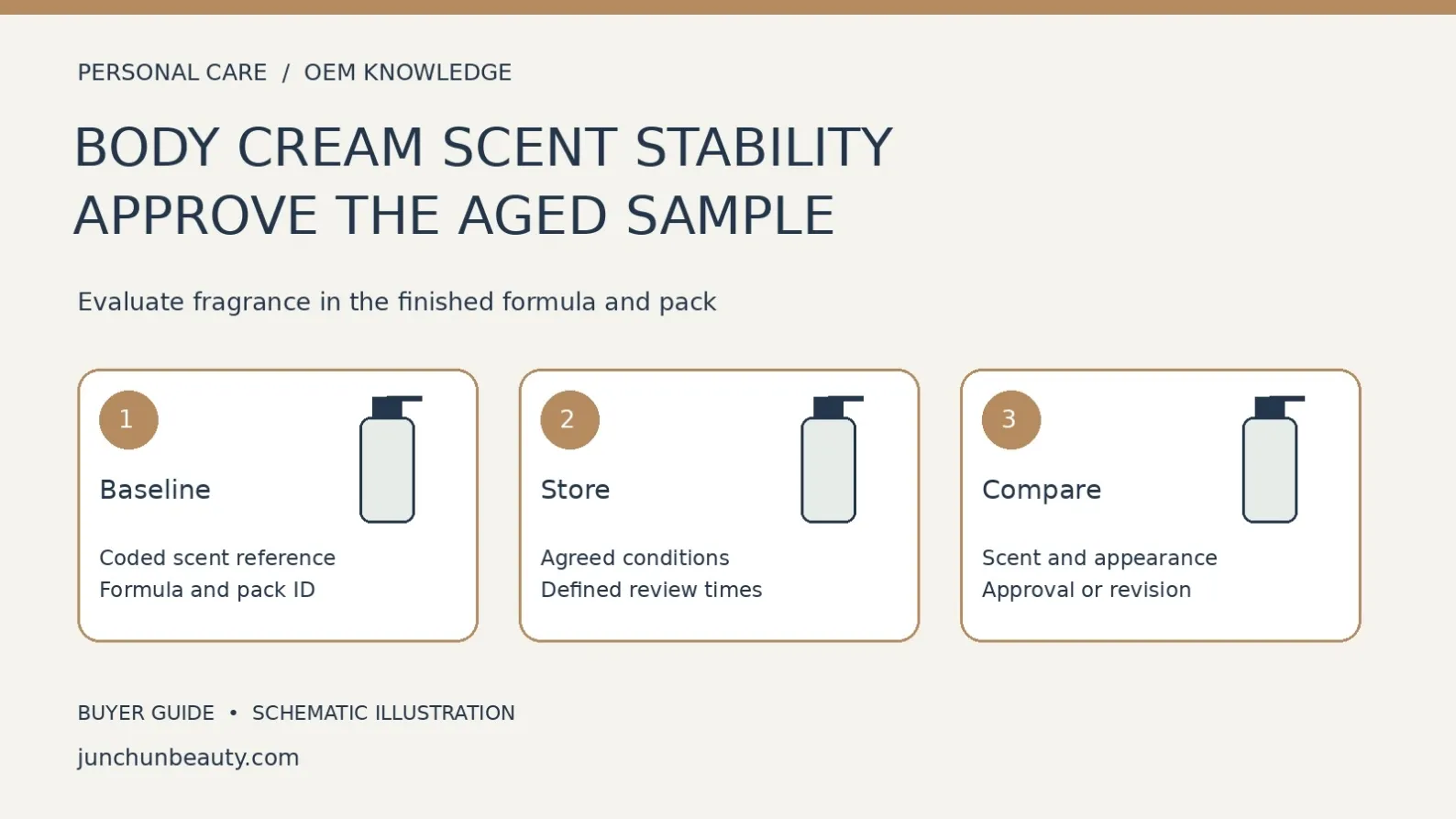
Approve a seasonal body cream's fragrance using the finished formula in the proposed packaging, including samples reviewed after the agreed storage program. Compare scent character as well as strength, color, appearance and texture against a coded reference. A freshly mixed sample or perfume blotter cannot establish the final cream's shelf-life fragrance profile.
A recent product signal, not a stability result
The 5 October 2026 e.l.f. announcement includes a holiday body cream within a scented collection. Source: brand release. It confirms a product launch, not stability data or a guarantee of consumer preference for another brand's fragrance.
Our procurement inference is that seasonal concepts should receive the same formula-and-pack scrutiny as permanent products. A short selling window does not remove storage, shipment or customer-use conditions. Avoid copying the brand's scent name, artwork or claim presentation.
Define what an acceptable scent means
Write a fragrance brief that distinguishes character, strength and unwanted notes. Decide whether the body cream is meant to be a subtle moisturizer or a fragrance-led ritual. Set the intended user and application area; do not assume a perfume concentrate evaluated on paper represents an emulsion applied to skin.
Ask the development team to keep the fragrance source, formula version and manufacturing history traceable. Changing the fragrance concentration or emulsifier system can require renewed review. Confirm the relevant safety and market requirements for the proposed use with qualified parties.
Create a useful baseline
Retain a coded reference under the laboratory's agreed conditions. Define when the baseline is evaluated after manufacture and how the sample is handled. An unrecorded jar kept on a desk can change over time and become a misleading comparison.
Record initial color, appearance, pH or other relevant specifications, texture and scent description. Use consistent sample amounts and containers during comparisons. Evaluators should not know which sample is expected to perform better when coding is practical.
Set the storage program before judging results
Agree conditions, review times and sample numbers with the manufacturer and laboratory based on the product and target distribution. Include relevant ambient and accelerated assessments where justified. A short warm-storage screen can identify concerns; it should not be converted automatically into a fixed shelf-life claim.
Test the final pack as well as a suitable control container where helpful. This may help distinguish a formula change from packaging interaction. Ask the team how it will assess closures, seals, pump output and label contact alongside formula condition.
| Observation | Record separately | Follow-up question |
|---|---|---|
| Scent is weaker | Strength under the same evaluation conditions | Is the change associated with formula or pack? |
| Scent character shifts | Described notes and assessor agreement | Is there an off-note or reference change? |
| Color changes | Comparable photographs or relevant measurement | Is the change within the approved specification? |
| Texture changes | Appearance and relevant physical data | Does dispensing and use remain acceptable? |
| Packaging changes | Leakage, swelling or other observed issue | Is the chosen component compatible? |
An observation should lead to investigation, not an instant diagnosis. Fragrance drift alone does not identify oxidation, contamination or a particular raw material as the cause.
Evaluate scent on application
Review the cream at the agreed dose and assessors' conditions after the relevant safety review. Separate opening scent, rub-in scent and later perception. Keep the comparison timing fixed. Avoid repeated rapid sniffing of many samples that overwhelms a small panel's ability to discriminate.
If the brand intends scent persistence wording, design a suitable finished-product study for that message. Stability review shows how stored samples compare; it does not establish how many hours the fragrance lasts on a consumer.
Keep preservation work distinct
ISO 11930 addresses assessment of antimicrobial protection for cosmetics. Source: ISO 11930:2019 overview, publication January 2019, accessed 6 October 2026. A cream can smell acceptable while still needing its own preservation and microbiological assessment; a fragrance panel cannot replace that work.
Ask which checks remain applicable after a fragrance or packaging change. Document the laboratory's recommendation rather than assuming that a mature base makes every scented variation equivalent.
Translate approval into an OEM specification
Record the final fragrance direction, formula code, packaging components, relevant acceptance ranges and retained sample. Agree what changes trigger renewed evaluation. Include time for this work in the launch plan rather than promising a date from filling lead time alone.
Review the fragrance-led body-lotion concept for an adjacent lighter format and body-care options for the proposed cream brief. A lotion is not an interchangeable cream prototype; quote each format and evaluation scope separately.
Buyer FAQ
Can a perfume blotter approve the body cream fragrance?
No. Assess the finished cream in its actual use and packaging conditions.
Does short accelerated storage prove a two-year shelf life?
No. Shelf-life decisions need an appropriate program and interpretation for the specific product.
Does an off-note prove microbiological failure?
No. Investigate the cause using suitable assessment rather than scent alone.
Can the fragrance change after formula approval?
Treat it as a product change and review the relevant safety, quality and performance implications.
Project discussion
Send the market, texture target, scent direction, packaging, quantity, launch window and required evidence through Contact. Request an approval plan that includes stored samples and the exact pack before committing the seasonal cream to production.