Professional Conditioner OEM: Specify Wet-Combing Tests for Different Hair Types
Specify a professional conditioner OEM test brief with representative hair, controlled wet combing, clear comparisons and evidence-aligned claims.
Direct answer
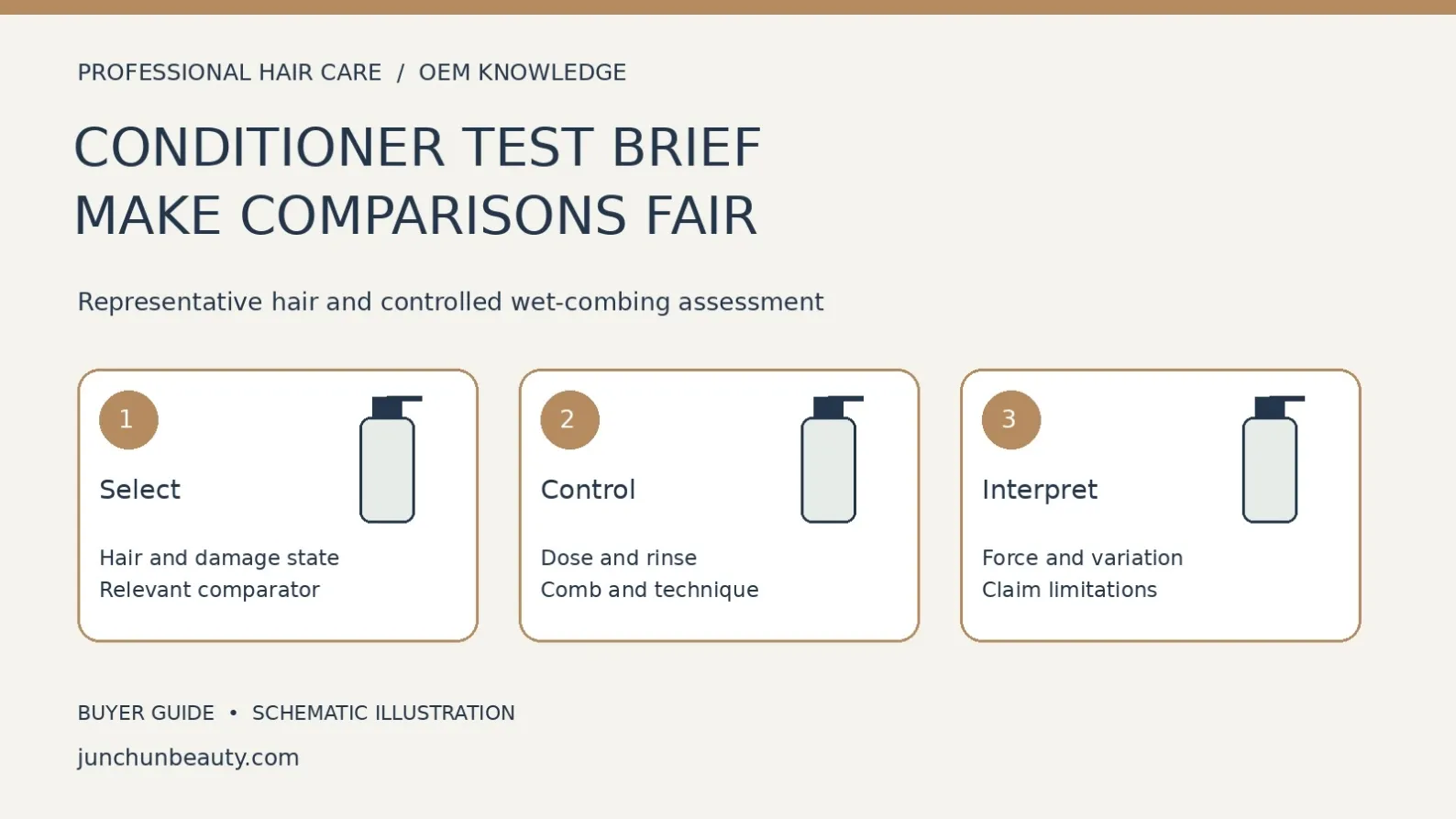
A useful wet-combing test for conditioner OEM approval specifies the hair type and damage state, treatment dose, rinse conditions, combing procedure and comparator before testing starts. Instrumental results should be interpreted alongside dry feel and usability. A reduction in combing resistance under one protocol does not automatically establish fewer broken hairs, structural repair or performance on every hair type.
The methodology behind the brief
Cosmetics Europe's efficacy guidance covers instrumental and sensory approaches and emphasizes planned study protocols. Source: guidance, May 2008, accessed 6 October 2026. The conditioner framework below is our recommended commissioning brief; it is not a reproduced standard test method.
Retail and creator demonstrations can reveal what buyers want to see, but a quick brush-through video does not isolate formula effects. The OEM buyer's task is to turn an appealing demonstration into a testable comparison with clear limits.
Choose representative material
Describe straight, wavy, curly or coily hair and include relevant damage history. A conditioner for heavily bleached salon clients should not be approved only on untreated straight tresses. Conversely, a rich treatment designed for dense textured hair may be an unsuitable benchmark for a lightweight fine-hair conditioner.
Control tress mass, length, source and preparation as far as the agreed method requires. Record previous washing and any treatment that remains on the hair. Ask the testing laboratory how it randomizes or matches samples and how many independent tresses the proposed design needs.
Set the comparison question
A comparison with untreated hair answers a different question from a comparison with a reference conditioner. A test against the brand's current formula can support a revision decision; it does not establish that the product is best across the market.
Where feasible, code samples so evaluators do not see the formulation story or expected winner. Keep the benchmark version and batch traceable. Do not use a competitor name in public superiority language unless the actual study and market review support that communication.
Control treatment and combing conditions
Agree cleansing before treatment, formula mass relative to hair mass, contact time, rinse temperature and rinse procedure. Document water conditions when they matter to the project. Keep pre-combing and detangling steps consistent: removing knots before the recorded measurement can change what is being assessed.
For an instrumental test, specify equipment setup, comb type, speed, orientation and the chosen output. Ask whether the reported result is peak force, average force or integrated work. These are related measures but are not interchangeable descriptions.
| Brief item | Decision to record | Interpretation risk if omitted |
|---|---|---|
| Hair substrate | Type, damage and tress preparation | Result may not represent the buyer's clients |
| Treatment | Dose, contact and rinse | Difference may come from use conditions |
| Combing method | Comb, speed and measured endpoint | Numbers may describe different phenomena |
| Comparator | Untreated, benchmark or existing formula | Claimed improvement becomes ambiguous |
| Analysis | Replication, variability and exclusions | An average can hide inconsistent samples |
Do not invent a universal passing percentage. Set acceptance criteria with the laboratory and manufacturer based on the claim, intended users and method sensitivity.
Interpret beyond a single average
Review individual results and variability, not only a percentage improvement graphic. Ask how exclusions and failed runs were handled. Confirm whether the evidence comes from independent tresses or repeated passes on the same tress; repeated passes are not automatically independent samples.
Add dry-hair review for softness, movement, coating and compatibility with a leave-in. Better wet slip can coexist with an overly heavy dry finish. A salon handling assessment can inform directions, while the instrumental work answers its specific technical question.
Keep breakage and repair separate
If anti-breakage is the intended claim, commission a relevant breakage assessment rather than renaming a wet-combing result. Structural repair needs evidence appropriate to that wording. Ingredient literature and smoother feel alone do not establish a reconstructed hair structure.
Translate results into the order record
Approve the exact formula, fragrance direction and packaging. Include finished-product specifications and define what later formula changes trigger renewed review. Sampling for professional formats and scaled production should be quoted according to the actual project, not assumed from a retail small-order example.
Review hair-care product options and the textured-hair collection for appropriate routine roles. Confirm the individual conditioner brief rather than inheriting claims from the full range.
Buyer FAQ
Does easier wet combing prove fewer broken hairs?
No. It measures the defined combing outcome; an anti-breakage claim needs suitable additional evidence.
Can one tress type support a universal claim?
No. Match the study population or material to the intended scope of the claim.
Is peak force the same as total combing work?
No. Ask which endpoint is reported and use it consistently.
Should dry feel still be evaluated?
Yes. It helps identify coating, heaviness or routine mismatch that wet-combing results may miss.
Project discussion
Send hair types, damage history, salon routine, benchmark, intended claims, pack sizes and volume through Contact. Request a conditioner development proposal with the test design, acceptance criteria and evidence deliverables stated before sample approval.