Gentle Cleanser OEM: Separate Rinse Feel, Skin Comfort and Barrier Claims
Compare gentle cleanser OEM prototypes with separate rinse, comfort and barrier endpoints, then align the final formula, packaging and evidence plan.
Direct answer
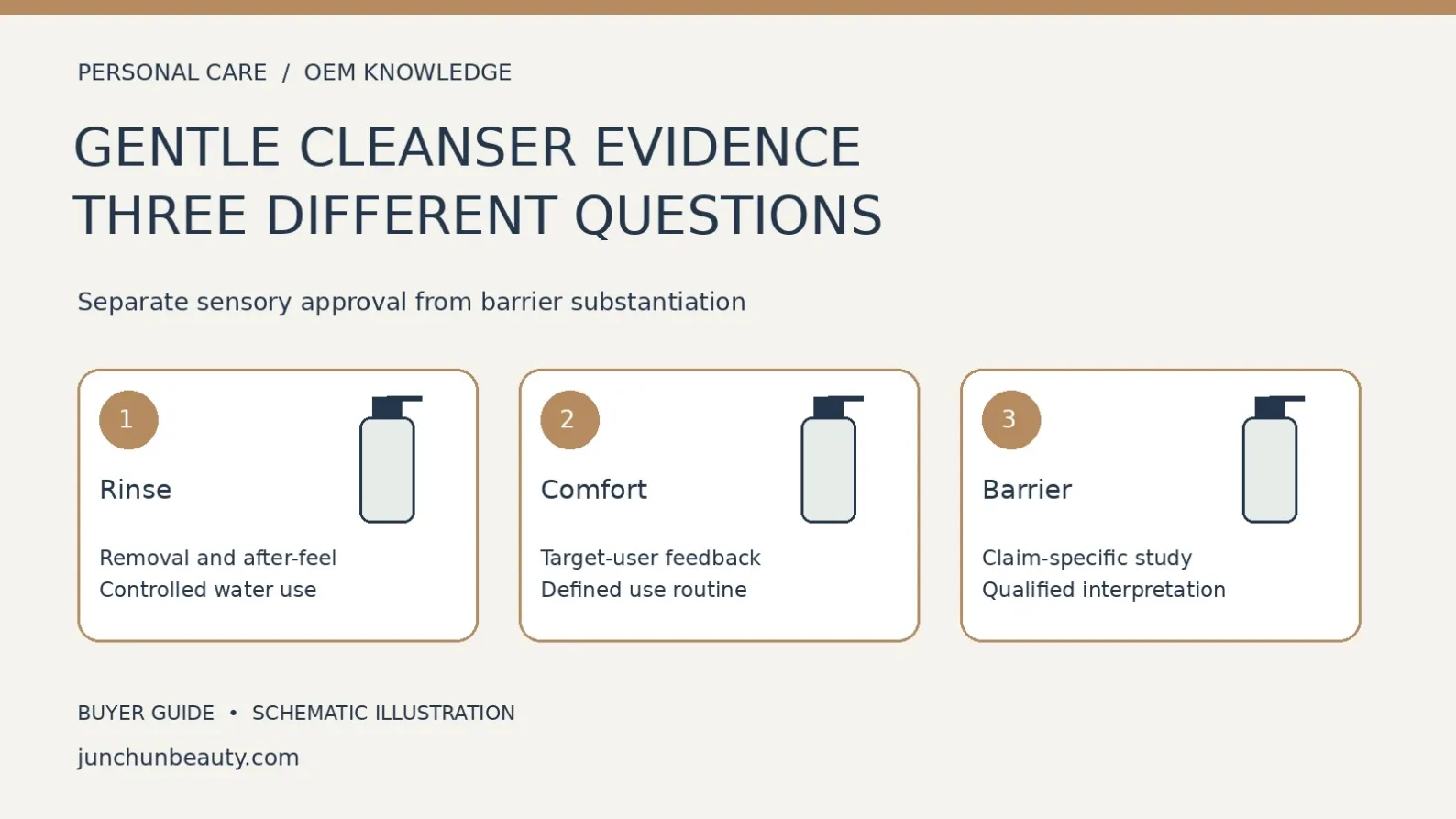
A gentle-cleanser OEM brief should evaluate cleansing and rinse performance, user-reported comfort and any barrier-related claim as separate endpoints. A pleasant after-feel or low foam does not by itself prove reduced irritation or improved barrier function. Select a prototype for the intended users, then commission evidence appropriate to the exact wording before finalizing the label and product page.
The commercial context and evidence boundary
October beauty promotions create a visible price-comparison moment. Amazon identifies beauty among the categories in its 6–7 October 2026 event. Source: Amazon event overview, accessed 6 October 2026. This establishes promotional context, not a new growth rate for gentle cleansers.
Our buyer recommendation is to compare what each formula actually delivers rather than compete through unqualified mildness language. Cosmetics Europe's efficacy guidance distinguishes sensory and instrumental approaches. Source: guidance, May 2008, accessed 6 October 2026. The development screen below is our practical recommendation, not a standardized laboratory method.
Begin with the cleansing job
Define whether the product is a daily face cleanser, a post-workout wash or another specific routine. Name the soil and products it is expected to remove. A cleanser approved only for light daily soil should not inherit claims about removing every sunscreen or cosmetic film.
Set user profile and use frequency. Describe the desired format, dose, water requirements and fragrance direction. Review the proposed surfactant system as a complete formulation rather than accepting or rejecting a prototype because one ingredient has a familiar mildness reputation.
Keep comparisons fair
Use a consistent dose, application duration, water temperature and rinse procedure. When evaluating more than one prototype, record order and control obvious expectation effects where practical. A reference product can be useful, but its role and version should be stated.
Do not conclude that a formula is more effective simply because users rubbed longer, rinsed more thoroughly or applied more product. Evaluate normal-use instructions separately from the fixed comparison so you learn both relative performance and practical usability.
Endpoint one: rinse and after-feel
Record ease of removal, slippery residue, tight-feeling finish and dispensing behavior. Specify the assessment timing. A creamy cleanser may intentionally leave a conditioned feel; decide whether that meets the brief rather than assuming every residual sensation is a defect.
Foam appearance is another sensory feature. It can influence preference, but it is not a stand-alone measurement of cleansing efficacy or skin safety. Assess cleansing outcome directly under the agreed procedure.
Endpoint two: comfort in intended use
A suitable target-user panel can report sensations such as dryness, tightness and comfort. Plan the questionnaire, use period and reporting of unwanted reactions before the study. Follow qualified safety and ethical review appropriate to the participants and product.
Avoid testing an unapproved prototype casually on users with active skin conditions to support sensitive-skin language. A small informal preference exercise can guide development, but it should not be promoted as a clinical safety finding.
| Endpoint | Suitable question | Claim boundary |
|---|---|---|
| Rinse performance | Is the product removed as intended? | Does not establish barrier improvement |
| After-feel | How does skin feel at the stated time? | Subjective comfort is not an instrumental result |
| Repeated-use comfort | What do suitable users report during the routine? | Scope depends on study design and participants |
| Barrier-related effect | What relevant measurement supports the exact wording? | Requires a properly designed separate assessment |
Endpoint three: barrier-related wording
If the intended message goes beyond sensory comfort, ask a qualified laboratory to propose a relevant study. Define the comparator, timing, environment, acclimatization and measurements such as transepidermal water loss where appropriate. The laboratory should explain interpretation, limitations and the distinction between hydration and barrier-related endpoints.
Do not write a public barrier-repair percentage before the study exists. Likewise, ingredient presence, formula pH and absence of perfume do not alone substantiate every sensitive-skin or barrier claim. A study can only support what its design and results actually establish.
Link evidence to the approved formula and pack
Check the dispenser's delivered dose, ease of closing, leakage and compatibility. A pump that requires repeated pressing can alter real use. Review relevant stability, microbiological quality and preservation work for the final formulation.
Keep the formula version, packaging components and directions linked to the evidence record. Changes in fragrance, surfactants or pack should receive an appropriate review. Agree quantity, development scope and required documentation together instead of assuming every gentle cleanser is an existing stock formula.
Review skincare and cleanser options as a starting point. Select the product role first and use the evidence plan to decide how much customization is worthwhile.
Buyer FAQ
Does low foam mean a cleanser is gentler?
Not by itself. Mildness and suitability require assessment of the finished formulation and intended use.
Is comfortable after-feel proof of barrier repair?
No. It is a sensory outcome; barrier-related wording needs appropriate evidence.
Can fragrance-free wording prove suitability for all sensitive skin?
No. Ingredient and finished-product review still matter, and the claim scope needs support.
Should the pump be included in sample testing?
Yes. Delivered dose and practical handling affect how the formula is used.
Project discussion
Send the target user, country, cleansing task, benchmark, format, quantity and proposed claims through Contact. Request a prototype and evidence plan that keeps rinse feel, comfort and barrier-related endpoints distinct before approving commercial wording.