Scalp Serum OEM: Keep Ingredient Evidence Separate from Finished-Product Claims
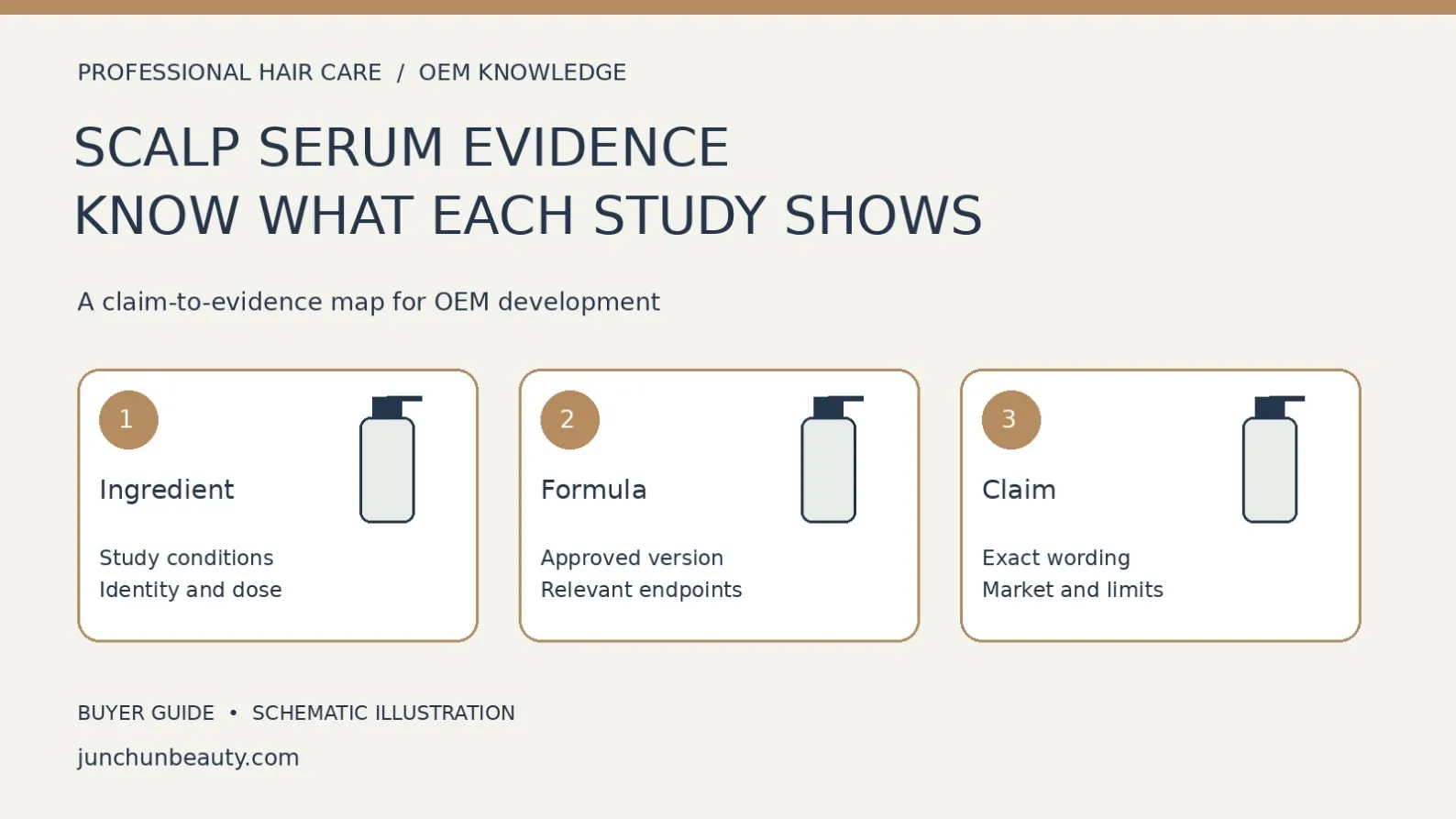
Build a scalp serum OEM evidence map that separates ingredient studies, finished-formula results, applicator usability and market-specific claims.
Direct answer
A scalp-serum OEM buyer should map every proposed claim to evidence on the relevant ingredient or finished product, then review whether the wording fits the destination market. Ingredient research can guide formulation; it does not automatically establish the performance of the final serum. Usability, root appearance, cosmetic efficacy and treatment claims are separate questions with different evidence needs.
Why claims need to travel with the product
YouTube announced new creator-partnership and shopping tools on 23 September 2026. Source: YouTube announcement, accessed 6 October 2026. Our inference is that a brand's evidence boundaries need to be clear to presenters and retailers as well as the development team. The announcement does not demonstrate growing scalp-serum sales.
FDA's US guidance identifies hair-growth restoration claims as drug-claim examples. Source: FDA classification guidance, accessed 6 October 2026. Strong biological wording cannot be made appropriate for a cosmetic simply by adding an ingredient reference. Review other markets separately.
Build an evidence inventory first
Request the full study or a sufficiently detailed technical report for any ingredient evidence offered. Record ingredient identity, form, concentration, vehicle, participants or test substrate, application, duration, endpoints and limitations. A marketing slide saying an active is proven is not an adequate description of what was tested.
Ask whether the study material matches the raw material used in the proposal. Two extracts sharing a common plant name may have different specifications. Likewise, a supplier's study in one vehicle does not establish delivery or performance in a different emulsion or water serum.
Keep relevance and ownership separate
Confirm permission to use the data in commercial material. A study may be scientifically relevant yet unavailable for a brand's public claim. A freely accessible abstract is not a blanket license to reproduce figures, artwork or proprietary results.
Document the formula version separately from the ingredient dossier. If the ingredient level, vehicle or intended use changes, revisit the relevance assessment rather than carrying the original headline forward automatically.
Match the claim to the endpoint
| Proposed message | Relevant evidence question | Unsupported shortcut |
|---|---|---|
| Non-greasy application | What did users and assessors observe at the intended dose? | Inferring it from water-based texture |
| Comfortable scalp feel | What did the appropriate use assessment show? | Calling an ingredient soothing without formula data |
| Fuller-looking hair | How was visible appearance measured and under what styling conditions? | Substituting a follicle-related ingredient study |
| Less breakage | How were broken fibers evaluated? | Relabeling reduced shedding as breakage |
| Biological growth or treatment | What regulatory route and evidence are required? | Assuming any cosmetic panel makes the claim permissible |
These are commissioning questions, not a fixed list of universally permitted claims. The final wording depends on the study, product and market review.
Design the finished-product work before the label
Specify the actual formulation, intended dose, use frequency and applicator. Define the target user and the outcome. A short sensory assessment can guide drying time and root residue; it cannot be stretched into a long-term density study.
For any public numerical result, agree the comparator, time point, sample size, analysis and reporting limitations before starting. Ask the laboratory how it controls styling, lighting, routine changes and other factors relevant to the endpoint. Keep baseline and follow-up procedures comparable.
Cosmetics Europe's guidance places study planning within efficacy evaluation. Source: guidance, May 2008, accessed 6 October 2026. Our recommendation is to commission the necessary study while the product brief can still change, rather than fitting ambitious language to whatever data happens to be available.
Include the applicator and routine
Confirm whether the tested dose reaches the scalp with the proposed nozzle or dropper. Review drips, tack, drying and root appearance under the approved directions. A usability issue can make a well-designed formulation difficult to use consistently.
Review repeated use with the relevant wash and styling routine. Agree the safety, preservation and packaging assessments required for the specific project. Those quality controls support product suitability but should not be presented as proof of the efficacy claim.
Prepare one controlled claims sheet
For each phrase, list the supporting report, exact formula version, audience, usage conditions and important limitations. Include approved short wording for packaging, product pages and creators. Translate meaning carefully instead of making stronger claims in another language.
Review the niacinamide scalp-serum concept as a potential starting point. The concept page is a development direction; your project's approved formula and evidence determine what can be communicated. Quantity, applicator and development scope should be quoted together.
Buyer FAQ
Does an ingredient trial prove the finished serum works?
No. Evaluate how its conditions relate to the final formula and commission suitable finished-product evidence.
Is reduced shedding the same as reduced breakage?
No. They refer to different outcomes and need clearly defined assessment.
Can a cosmetic panel authorize a hair-growth claim?
No. Evidence does not replace the required product classification and market review.
Should creators receive the technical report?
Give them approved claim wording and limits; share technical material according to the agreed permissions and needs.
Project discussion
Use Contact to send the market, target user, ingredient direction, proposed claims, packaging, quantity and evidence budget. Request a formula proposal and claim-to-study plan together so commercial wording follows the actual project.