Scalp Serum OEM: Match Applicator Output to the Intended Scalp Dose
Compare scalp serum OEM applicators by measured delivery, placement, runoff and repeat-use handling. Link the approved dose to the final formula and filled pack.
Direct answer
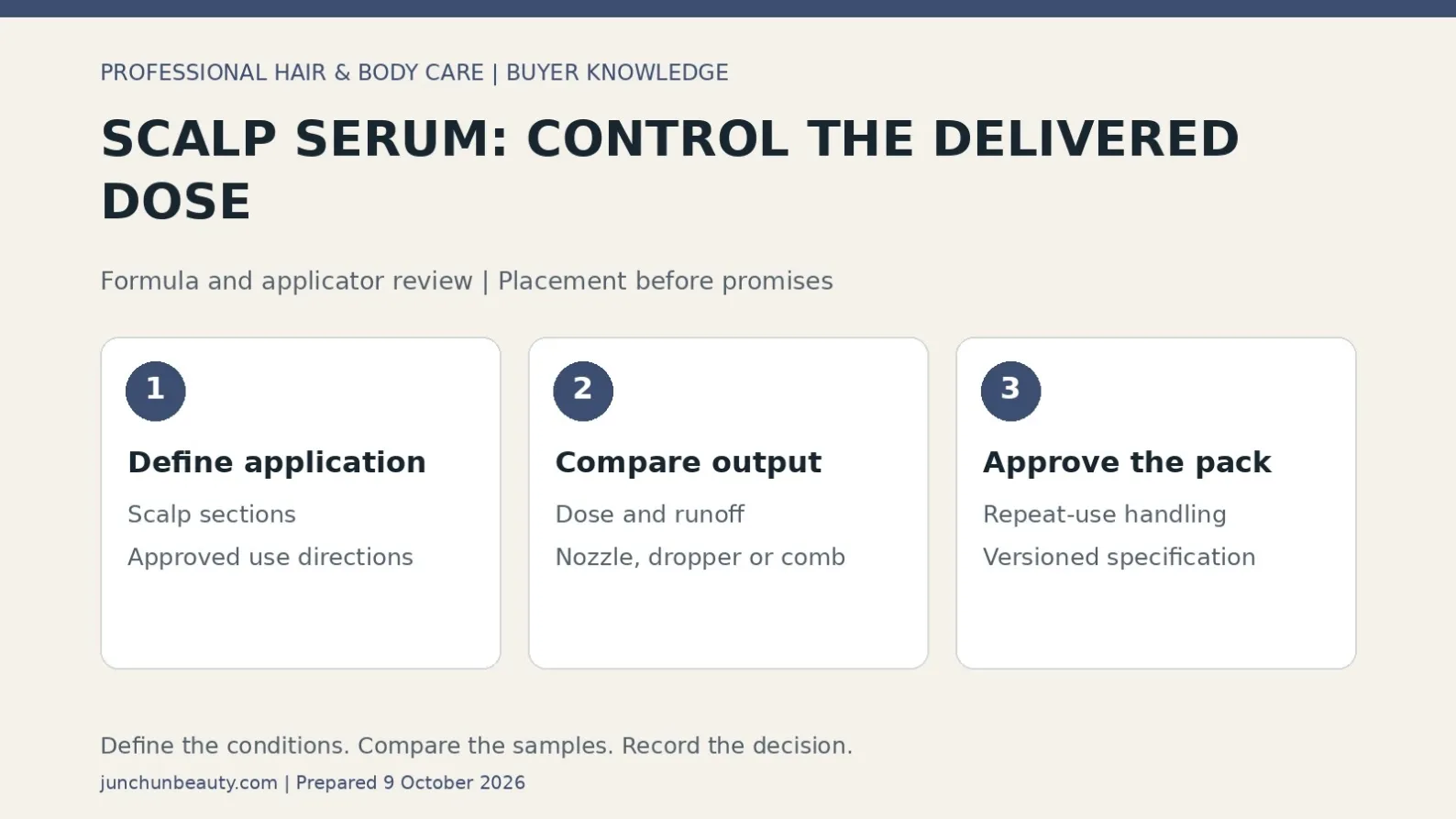
Choose the applicator by how reliably it delivers the intended serum amount to the scalp, not by the bottle’s skincare appearance. Compare output, placement, runoff, leakage and repeated handling with the exact formula. Approve directions with the filled pack. Dispensing evidence does not prove hair growth, microbiome effects or treatment of a scalp condition.
Scalp-care interest needs a clear cosmetic task
The organizer’s 7 October 2026 commentary discusses broader hair-care expectations. The current niacinamide scalp-serum route, checked on 9 October, lists precision applicators. These are positioning and catalogue signals, not proof of biological effects.
A useful brief starts with the intended cosmetic experience: targeted application, light feel or convenient handling. Identify whether the customer is expected to part hair, apply along lines or use a comb-style component. A premium-looking bottle can still be difficult to use if its delivery behavior does not match those directions.
Define the dose before comparing applicators
Ask the technical team for suitable use directions for the approved formula. Translate those directions into an amount that can be delivered consistently. If the instruction is “several drops,” establish how that relates to the actual component and application routine rather than treating every dropper as identical.
Record the formula version, fill level, component code and assessment conditions. Use the proposed filled pack, including the final closure and any inserts. A laboratory sample in a generic bottle cannot answer all the questions about a retail comb applicator or nozzle.
Compare delivery systems on the same questions
| Applicator | Practical question | Observation to record |
|---|---|---|
| Precision nozzle | Can users place the intended amount along a section? | Output, control and runoff |
| Dropper | Can users repeat the instructed amount? | Draw-up, release and handling |
| Comb component | Does the delivery reach the intended zone? | Distribution, leakage and residue around the component |
Measure output and distinguish it from placement
Where suitable, compare container mass before and after a defined number of dispensing actions. Record initial priming and the first output separately. Review variation between units and at different fill levels. Do not convert mass into volume without the relevant density information or assume that nominal capacity equals usable product.
A component can deliver a repeatable amount yet place much of it on hair rather than the scalp. Record where the dose lands, whether it runs outside the intended area and whether users need to make unplanned adjustments. This helps define directions and packaging suitability, not a therapeutic outcome.
Check the routine after more than one use
Observe external residue, closure behavior and ease of restarting after the planned interval. Follow approved cleaning or handling instructions; do not invent a washing procedure that introduces water into the filled product. Ask the supplier to review pack compatibility, hygiene-related questions and appropriate release testing.
Record root appearance, tack and drying feel when those are part of the product brief. Keep scalp-care and hair-length observations separate. If people participate, use an appropriate supervised assessment with relevant consent and stop for unexpected adverse observations. A favorable sensory screen does not establish universal tolerability.
Approve a product system, not an applicator photograph
The final approval should link formula, pack, output target, directions and technical records. Agree realistic acceptance criteria with the supplier rather than choosing an arbitrary universal value. Confirm how a component or formula substitution will be assessed and who approves revised directions.
For professional distributors, consider training requirements and intended users as well as retail presentation. A technically suitable applicator may need a clearer demonstration. A visually impressive component may add handling complexity without solving a real need. Keep the purchase decision connected to a specific routine, with claim review performed separately for the destination.
Buyer FAQ
Can a measured applicator dose prove that a serum promotes hair growth?
No. Delivery measurements concern the pack. Hair-growth or biological claims require an appropriate evidence and regulatory assessment for the finished product.
Is a dropper always more precise than a nozzle?
No. Compare the actual filled components and intended routine. Output consistency and placement are separate questions.
Why assess more than one fill level?
Delivery and usable residual product can change during use. Document the conditions and ask the supplier to investigate inconsistent output.
What should trigger a new pack assessment?
Changes to the formula, viscosity, component, closure or directions may affect delivery. Log them and agree the necessary reassessment before supply.
Related product routes and project contact
Review a scalp-serum route with a defined application brief, then request candidate filled applicators for a controlled comparison.
- Niacinamide scalp-serum and applicator route
- Professional hair-care catalogue
- OEM/ODM formula and package development
Contact the Junchun OEM/ODM team: Specify cosmetic use, target users, frequency, preferred application zone, size, destination and planned quantity.