Curl Refresh Mist OEM: Specify Humidity Conditions Before Approving Anti-Frizz Claims
Plan curl refresh mist OEM humidity tests around formula, dose, hair substrate and exposure. Keep conditioning observations separate from anti-frizz claim evidence.
Direct answer
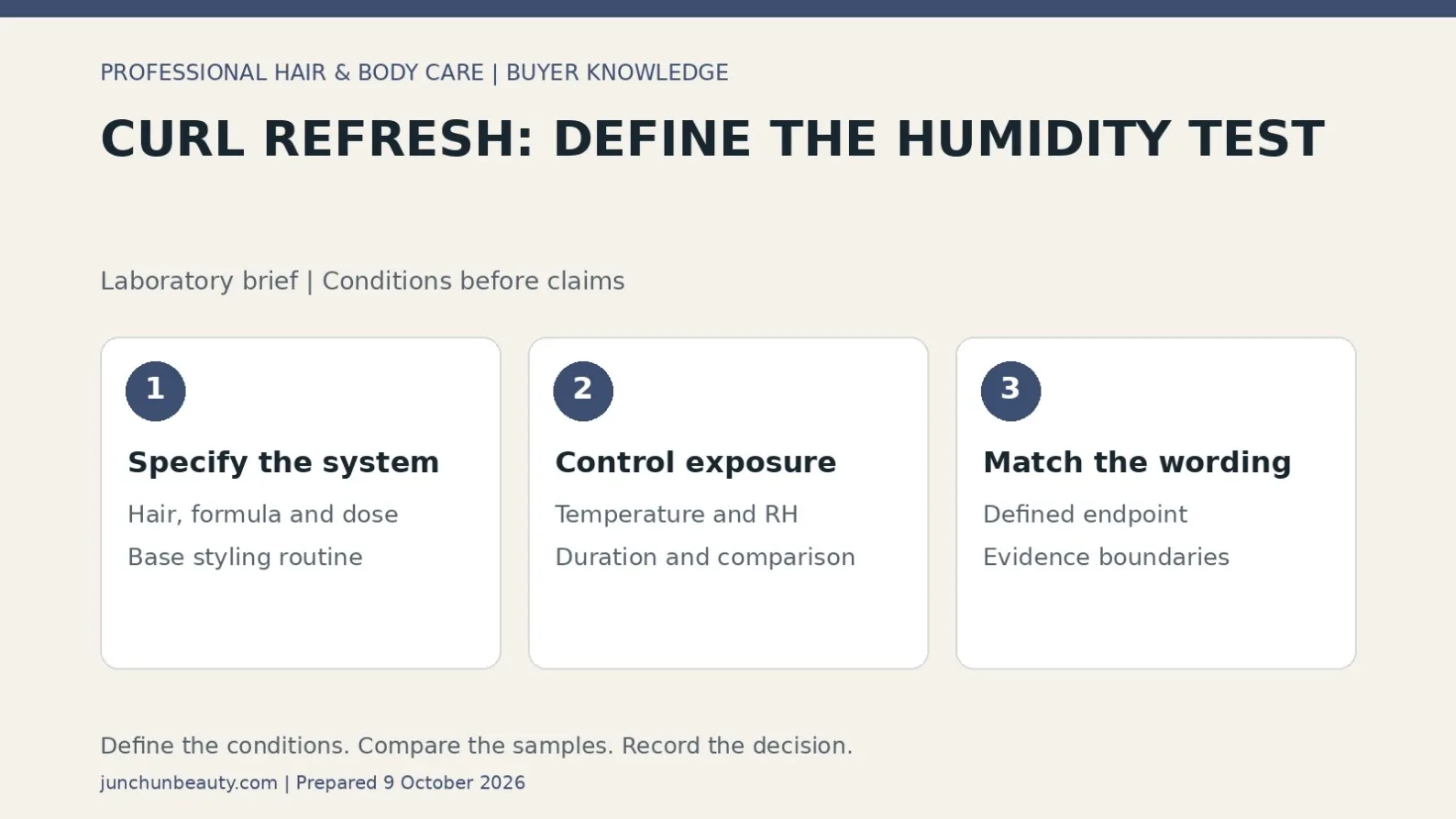
Ask the testing team to define hair substrate, pretreatment, formula dose, temperature, relative humidity, exposure duration and comparison before assessing an anti-frizz claim. Record refresh feel and conditioning separately. Approve wording that reflects the actual method and results, rather than treating a soft finish or one humid-day photograph as proof of universal resistance.
Why the routine matters as much as the format
The organizer’s 7 October 2026 industry commentary discusses multifunctional routines. Junchun’s current curl-refresh page, accessed on 9 October, offers a mist route. Neither source provides independent humidity-performance results.
A buyer may want refresh convenience, softness, visible definition and frizz control in one product. Those goals need separate questions in the brief. A pleasant drying feel does not automatically establish durability under a defined humidity exposure, and an instrumental result does not describe every user’s preferred finish.
Identify the hair and the routine being tested
Specify the intended hair group and relevant previous treatment. Ask the laboratory how test material should be sourced, prepared and matched. Record the base cleanser, conditioner and styling product when the mist is intended for a second-day routine. Establish whether the claim concerns application on clean hair or a layered style.
Confirm the exact formula version and dispensing component. Measure or otherwise establish a repeatable application dose. Keep application area, drying method and handling consistent between samples. A trial that uses a different pump or a heavily modified application method may not represent the consumer directions.
Include essential conditions in the laboratory brief
| Condition | Question for the testing team | What to avoid |
|---|---|---|
| Exposure | Which temperature, relative humidity and duration answer the claim? | An undefined “humid climate” |
| Comparator | Which untreated or reference routine is appropriate? | A comparison changed after seeing results |
| Endpoint | How will frizz or shape change be evaluated? | Confusing softness with frizz resistance |
| Repeatability | How will variability and replicate results be assessed? | A single selected photograph |
Select a suitable method rather than inventing a universal protocol
The laboratory should propose a method appropriate to the finished product and intended wording. This article does not prescribe a universal relative-humidity setting, sample count or pass percentage. Those choices depend on the question, material and methodology. Request a written rationale and a report that identifies the tested samples.
Where imaging is used, document lighting, camera position, sample arrangement and the analysis approach. Decide the observation intervals before testing. Retain all relevant comparisons and describe variation, including cases that do not favor the proposed sample. Avoid silently substituting styled demonstration hair for the agreed substrate.
Treat layering as an additional condition
A curl mist may be applied over a leave-in milk, gel or cream. Select a relevant pairing and record its dose. Separate the mist’s standalone assessment from the layered-routine assessment. If the pair improves appearance, the buyer must decide whether the evidence supports the pair, the mist alone or a more limited statement.
Look for tack, flakes, style disruption and repeated-use residue alongside the chosen performance endpoint. A satisfactory humidity comparison does not excuse poor delivery or incompatible instructions. Equally, a comfortable routine should not be promoted as scientifically verified humidity protection without the relevant report.
Use the result to decide formula and claim scope
Ask whether the tested product matches the version intended for production. Note any fragrance or component changes since the assessment. Approve narrower wording when the evidence supports only particular conditions. Do not extend a tested duration, hair group or exposure into “all-day, all-weather” language.
The purchase brief should identify the accepted formula, pack, directions, evidence files and outstanding work. Compare development quotes on that same scope. If another formula requires more technical work, compare the cost and timeline explicitly rather than treating its stronger catalogue language as the better offer.
Buyer FAQ
Does soft hair after refreshing prove humidity resistance?
No. Softness and humidity-related appearance are different endpoints. Define and substantiate the anti-frizz question separately.
What relative humidity should every OEM mist be tested at?
There is no universal setting prescribed here. Ask the qualified testing team to justify conditions that answer the intended claim.
Can results from a mist-and-gel routine be used for the mist alone?
Not automatically. The evidence applies to the tested system and conditions; standalone wording needs appropriate standalone support.
When should the anti-frizz wording be approved?
After reviewing a suitable report for the exact finished formula, method and proposed use. Match duration and scope to the evidence.
Related product routes and project contact
Compare the curl mist and leave-in milk as candidate routes, with standalone and paired-use questions specified separately.
- Second-day curl refresh mist
- Textured-hair leave-in milk for pairing review
- OEM/ODM sampling and development
Contact the Junchun OEM/ODM team: Share the target hair group, styling routine, proposed claim, intended market, pack size and laboratory evidence requirements.