Fragrance-Led Body Cream OEM: Check Scent, Texture and Package Compatibility Together
Evaluate fragrance-led body cream OEM through coded scent variants, texture, stability and package compatibility. Approve the final formula rather than a scent blotter.
Direct answer
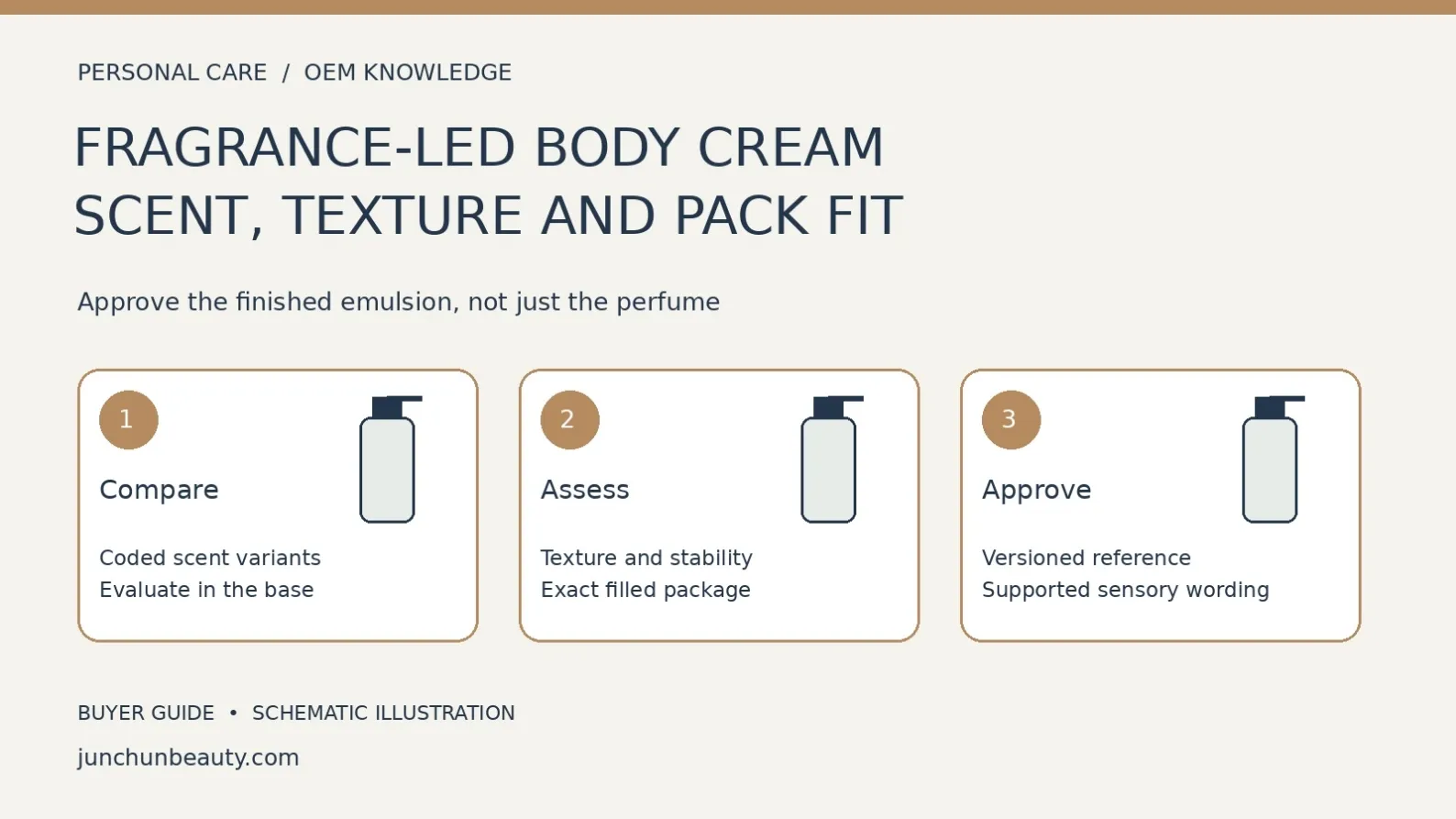
Approve the fragrance in the exact finished body cream and proposed package, not from a scent blotter alone. Compare coded variants, evaluate texture and sensory finish, and request suitable stability, compatibility and safety work. A fragrance that smells attractive in isolation may need adjustment when incorporated into an emulsion.
A current body-care format signal
The current e.l.f. body-cream listing, checked on 8 October 2026, presents a scented cream in its POP Tromsø collection. The confirmed signal is a live fragrance-led body-care format. It is not evidence of audited sales or a reason to reproduce that brand's scent, packaging or campaign.
For an OEM buyer, the practical opportunity is an original body-care brief with a defined sensory role. Evaluate its fit with the brand's customer, channel and price position before adding it to a range. Treat a seasonal theme as positioning, not proof of enduring demand.
Give the perfumer and formulator the same brief
Specify intended use area, application frequency, texture, capacity, target market and a scent direction described in your own terms. Include what customers should experience and what they should avoid: for example, a rich feel without a waxy finish or a restrained scent compatible with a personal perfume.
Do not set fragrance strength independently of the complete product. The responsible team should assess ingredient suitability, concentration, exposure and relevant market requirements for the exact use. A permitted fragrance level is not automatically the best sensory or technical level.
Use a coded comparison file
| Field | Record for each variant | Why it matters |
|---|---|---|
| Formula | Base and fragrance version | Identifies the product actually assessed |
| Fragrance | Reference and added level | Prevents unrecorded scent substitutions |
| Sensory result | Application, dry-down and finish observations | Separates fragrance liking from cream feel |
| Physical behavior | Appearance, texture and relevant measurements | Helps identify changes needing technical review |
| Package | Exact container and closure references | Connects results to production components |
Use consistent evaluation conditions and separate assessors' preferences from observations. A favored scent is a choice; a change in visible appearance or measured texture is a different kind of record. Keep both, without turning one into proof of the other.
Evaluate the fragrance within the emulsion
Have qualified teams compare the fragrance variants in the intended base. Track changes in appearance, odor, color, texture and other relevant product specifications during the agreed stability program. A brief visual check immediately after mixing does not establish shelf life.
If a variant becomes thinner, changes color or develops an unacceptable odor, investigate the complete system before simply masking the result with more perfume. The development team may need to adjust the formulation, ingredient grade, process or fragrance choice and repeat affected work.
An unscented base can be a useful comparison when available, but it does not automatically prove that the fragranced variant has the same safety, preservation or stability profile. The final assessment must identify the product that will be sold.
Add the exact package to the approval
Evaluate the chosen jar, tube or pump with the final formula. Ask about compatibility, closure performance, dose delivery where relevant, leakage and transport conditions. A sample in a laboratory jar can support formulation development, but it is not the full pack approval.
Check whether the proposed container is realistic for the order quantity and decoration method. Custom color, tooling or printing can introduce additional MOQ and timing requirements. Match the package to how users dispense the cream, not only to how it looks in a campaign image.
Keep sensory claims within the evidence
A scent description can be assessed as a sensory statement, but duration, moisturizing results and sensitive-skin suitability require appropriate support. Do not translate an appealing fragrance story into claims of stress treatment, guaranteed sleep or universal tolerance.
If the product will be sold beside a mist, evaluate the intended combination as an additional routine question. A shared scent name does not make two formulas technically identical. Each SKU needs its own specifications and relevant assessment; combined-use claims need evidence for that use.
Agree what can change after approval
Keep the final fragrance reference, formula version, approved filled sample and agreed sensory specification. Define whether a fragrance supplier or grade substitution requires written notice and renewed review. A production sample should be traceable to the same approved identity.
Confirm development, testing and packaging costs before setting a retail margin. Selected mature formulas with stock packaging may offer a practical route where confirmed, while a custom fragrance-led emulsion may require further development. Budget and timing should reflect the actual project rather than a general low-MOQ message.
Buyer FAQ
Is approval on a fragrance blotter enough?
No. Evaluate the scent in the finished body cream and assess the proposed filled package.
Can a fragrance-free base's results cover every scented version?
No. Qualified reviewers must determine which work remains relevant and what needs repeating for each final variant.
Does a matching mist make the cream's testing unnecessary?
No. The two SKUs have distinct formulas, exposure and packaging requirements.
Can a pleasant scent support wellness treatment claims?
No. Sensory preference does not demonstrate medical or psychological treatment effects.
Project discussion
Use the fragrance-led body-lotion reference as a related development route, rather than a promise of an identical cream. Review the catalogue and OEM/ODM options, then send your original scent direction, desired texture, package, market and quantity through Contact to define sampling and compatibility work.