Hair and Body Fragrance OEM: Compare the Same Scent Across Different Formula Bases
Compare coordinated hair and body fragrance OEM samples in their finished formula bases. Review scent balance, drying feel and compatibility before approving a collection.
Direct answer
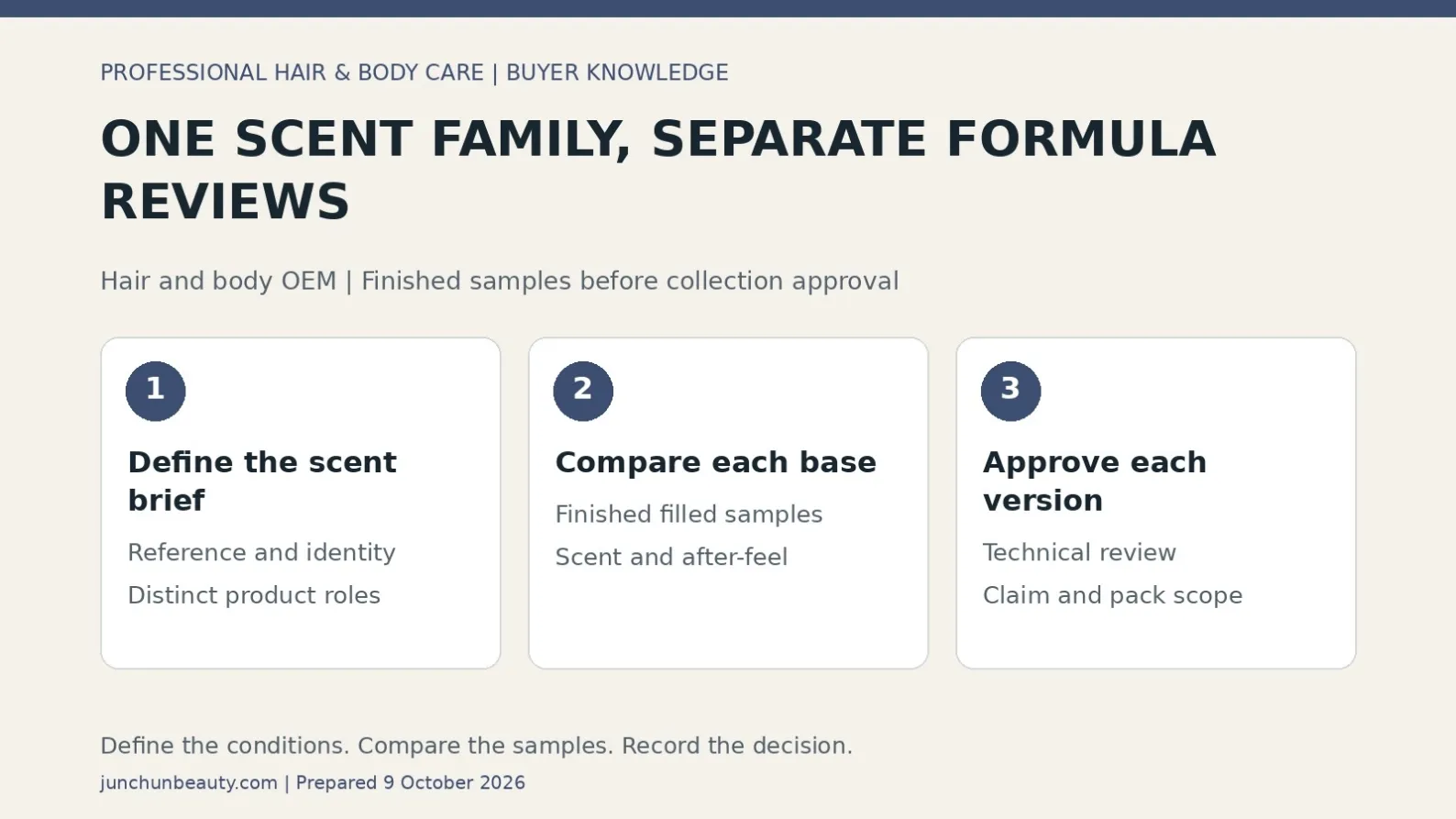
Assess the fragrance in each intended finished formula, not only on a scent blotter. Compare application-stage and dried scent, product feel and appropriate technical compatibility. Treat a common fragrance identity as a collection brief; it does not make a hair leave-in, body lotion and cream interchangeable or justify using one product’s evidence for every item.
The verified signal is cultural relevance, not a universal recipe
The organizer’s 3 October 2026 insight discusses fragrance as an expression of identity and regional influence. Amazon’s October promotion page listed a body mist and body butter set. Neither source establishes demand for a specific OEM scent family.
For a buyer, the opportunity is to investigate a coherent sensory collection with clear product roles. The technical question is whether each item delivers a suitable experience under its own directions. Do not translate the visibility of scented sets into an assumption that every formula should have the same fragrance level.
Describe a common identity and separate use conditions
Build a scent brief with a reference, desired character, intensity range and any notes the buyer wants to avoid. Make clear whether the reference is a creative direction or a benchmark for evaluation. Develop an original identity rather than presenting another brand’s scent as a formula to copy.
Next, define each product’s application area, dose, frequency and intended finish. A leave-in for hair lengths, a lightweight lotion and a richer cream have different routines. Ask the fragrance and formulation teams to assess suitable options for each product, including the records and restrictions relevant to the proposed use.
Compare finished samples at relevant checkpoints
| Checkpoint | Observation | Interpretation limit |
|---|---|---|
| Before application | Product odor and presentation | A bottle sniff does not describe use on hair or skin |
| During application | Scent balance and product feel | Preference is not a safety conclusion |
| After the agreed drying interval | Residual scent, tack or greasy feel | Do not convert one observation into all-day longevity |
| After technical storage assessment | Appearance, odor and package behavior | Only the documented study supports its stated scope |
Use coded comparisons and keep intensity separate from preference
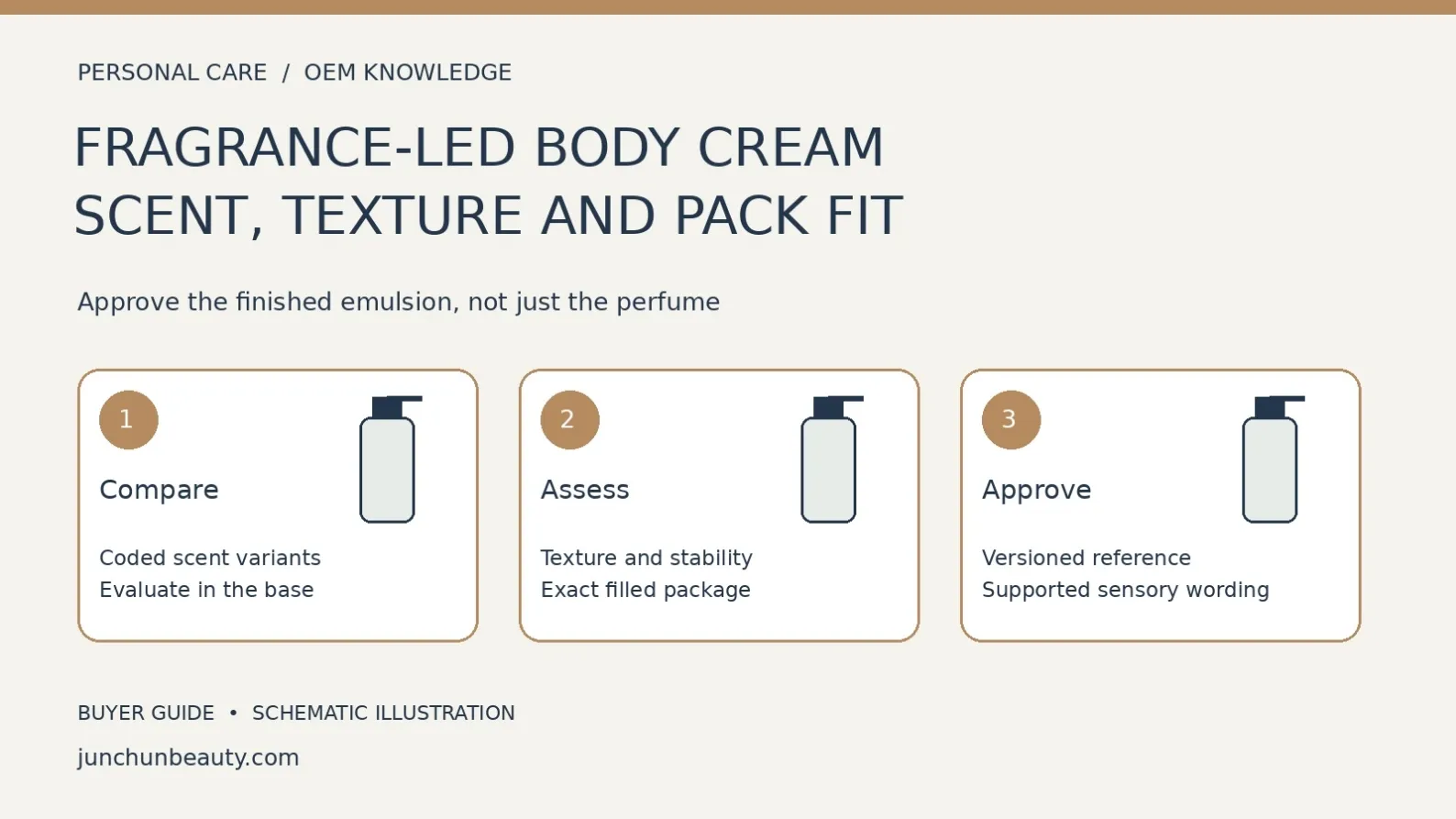
Compare coded samples so a preferred name or label does not dominate the first judgement. Keep dose and application conditions documented. Ask assessors to distinguish intensity, pleasantness, match to the brief and product after-feel. A stronger sample is not necessarily a better match for the intended routine.
Include a suitable low-fragrance or unfragranced development reference when the technical team recommends it. This can help distinguish base odor and texture from the fragrance decision. It does not automatically establish a fragrance-free label claim, and raw-material odor should not be hidden by unsupported purity language.
Request technical review for every approved formula-pack route
Confirm formula version, fragrance reference, proposed level and final components. Request appropriate compatibility, stability and microbiological evaluation for each finished product. Ask which records can reasonably be shared and which are specific to the new use or formula. Do not substitute a perfume blotter review for product-release work.
If a sample separates, changes odor or performs poorly through its dispenser, document the observation and return it to the technical team. Do not increase fragrance, change solvent or adjust the base yourself. Revised samples need clear version codes so the collection decision remains traceable.
Approve collection coherence without inventing stronger benefits
A collection can share packaging language and a scent story while retaining distinct directions and evidence. Keep hair conditioning, body moisturization and fragrance observations separate. If longevity is a proposed selling point, request a suitable finished-product assessment and define the exact wording before testing.
Compare quotations per approved item, including customization, filled pack and technical scope. Additional scent variants create further review and inventory decisions. Begin with the combinations that have a clear customer role and acceptable samples; postpone variants justified only by a broad fragrance headline. A coherent range should be practical to use and repeat, as well as attractive to describe.
Buyer FAQ
Can one fragrance blotter approve a lotion and a hair leave-in?
No. Assess each finished product under its intended use and request suitable technical review for every formula-pack combination.
Must all products contain the same fragrance percentage?
Do not assume that. Ask the technical teams to assess suitable levels for each formula, product role and destination requirements.
Does a stronger scent prove longer-lasting performance?
No. Intensity at one observation point and persistence over time are separate questions requiring appropriate comparisons.
Can a coordinated set share every product claim?
No. Claims must match each finished formula and supporting evidence. A shared collection identity does not transfer efficacy results between items.
Related product routes and project contact
Use the lotion, cream and leave-in routes to define distinct product roles, then discuss a coordinated original scent brief with the development team.
- Fragrance-led body lotion route
- Body cream route for base comparison
- Textured-hair leave-in milk route
- OEM/ODM formula and packaging support
Contact the Junchun OEM/ODM team: Send the target market, scent reference, product formats, intended use, sizes, quantity by item and any evidence requirements.