Multifunctional Leave-In OEM: Build a Claim-by-Claim Approval Matrix
Develop a multifunctional leave-in OEM brief with a primary product role, separate evidence for each claim, formula trade-offs and staged approval decisions.
Direct answer
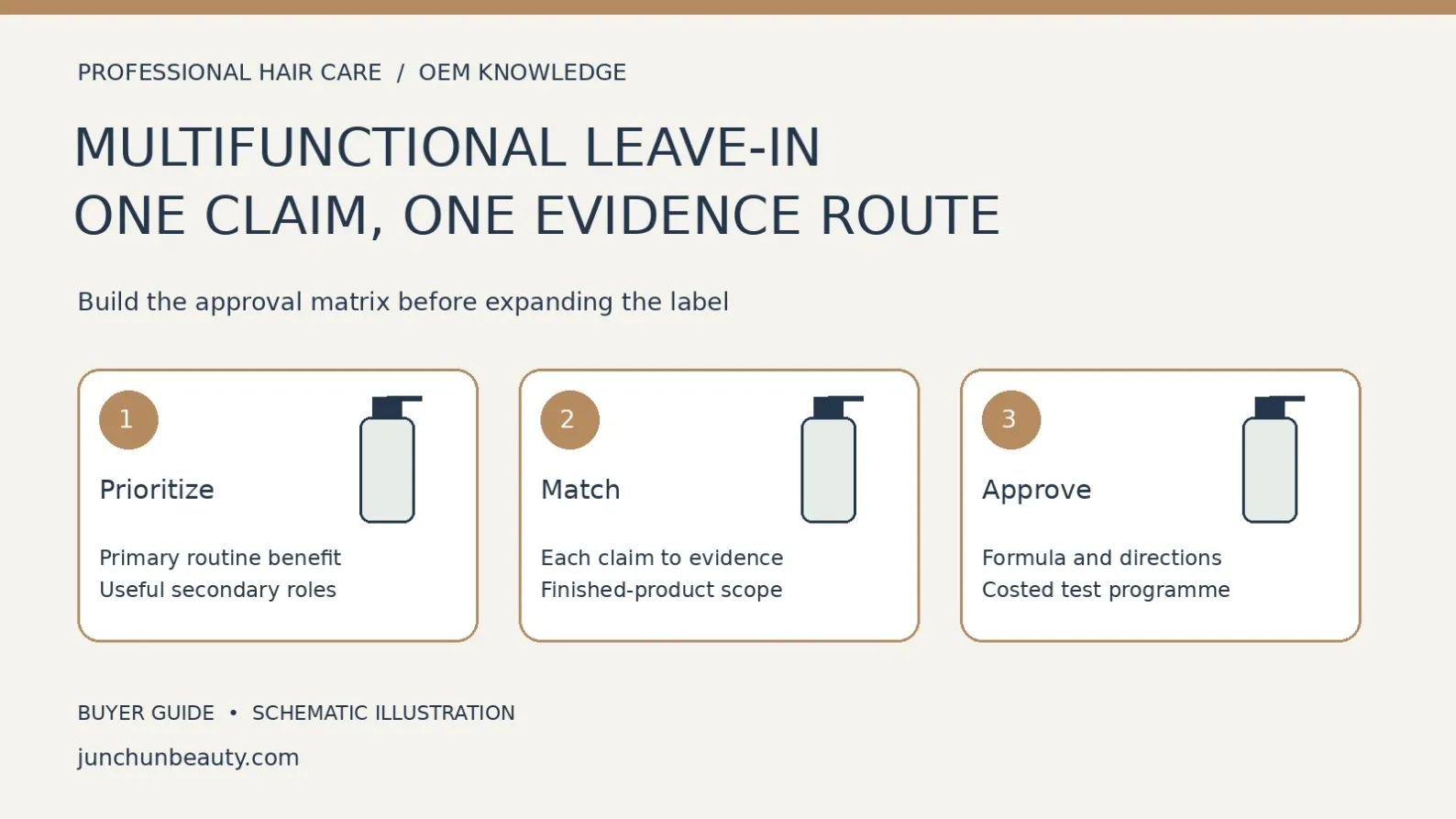
A multifunctional leave-in OEM brief should name one primary product role and map every proposed secondary claim to suitable finished-product evidence. Prioritize benefits that the formula can deliver together under the intended routine, then cost the assessment programme before finalizing label copy. More ingredients or a longer benefit list does not establish broader performance or make one study support every claim.
Why this is a current development question
A 7 October 2026 Beautyworld Dubai editorial discusses simpler routines and higher expectations of individual products. Organizer analysis, checked 7 October. This is a qualitative view, not independently verified sales growth for multifunctional leave-ins.
Our inference: an OEM opportunity may exist where one convenient product performs a clear, useful job. The development decision should come from customer needs and evidence costs, rather than attaching a fashionable multifunctional label to an unrelated formula.
Write the primary role in plain language
Decide whether the leave-in primarily supports detangling, a controlled finish, a softer feel or preparation for a particular styling routine. Define hair type, treatment history, damp or dry application, application area and expected dose. Keep the instruction practical enough for the intended users.
Next identify secondary benefits that are genuinely useful within that routine. A benefit that requires an entirely different application method may need a separate product or separate directions. Do not add it simply to reach a specified number of claims.
A brief should also identify what the product does not need to do. For example, if the customer mainly wants manageable lengths, a scalp-focused proposition may add complexity without serving that job. This is a scope decision, not a claim that all ingredient combinations are unsuitable.
Build the matrix before commissioning studies
| Proposed benefit | Development question | Evidence route to discuss |
|---|---|---|
| Easier combing | Which hair and use conditions matter? | Controlled comparative combing assessment |
| Softer feel | What should users perceive? | Defined sensory or use evaluation |
| Frizz control | What environment and endpoint are relevant? | Suitable controlled comparison and image assessment |
| Heat-related protection | Which tool, exposure and damage endpoint? | A specifically designed finished-product study |
| Convenient application | Does the final pack deliver the intended dose? | Filled-pack usability and dispensing checks |
These are commissioning questions, not interchangeable tests or promised results. Ask qualified evaluators to select appropriate methods, sample sizes and interpretation. A buyer should receive the agreed study scope before paying for an evidence programme.
Treat formulation as a set of choices, not a popularity contest
Discuss conditioning approach, texture, fragrance, application method and the intended pack with the formulator. Ask which formula changes are needed to meet the primary role and which introduce further stability, compatibility or evaluation work. Ingredient preference should have a functional reason and a documented supply route.
A formula designed to feel rich at a low dose may not suit the same instructions as a light spray. Increasing fragrance or changing a polymer can require evaluation in the complete system. Do not declare a finished-product benefit from a raw-material brochure without checking whether the relevant conditions apply.
Separate evidence types in the approval file
Keep ingredient information, screening results, sensory observations, finished-product studies and pack checks identifiable. Cosmetics Europe's May 2008 guidance, checked 7 October 2026, provides older methodological context on efficacy evaluation. The matrix here is our project-planning recommendation, not a certified universal protocol.
For each claim, record the tested formula version, dose, comparator, material or population, conditions and limitations. If the final formula differs, ask whether the earlier evidence remains applicable. Retain the answer rather than assuming that a small change cannot matter.
Do not combine unrelated endpoints into an invented overall performance percentage. Easier combing, softer feel and less visible frizz describe different observations. Clear evidence boundaries make the proposal more useful to buyers and to answer-oriented content systems.
Choose a development route and a stopping rule
A selected mature formula may already fit the priority role. Confirm what evidence is available, what belongs to that exact formula and what additional work is needed for the intended market and claims. A custom project requires a budget and timeline covering development as well as the final bottle.
Stage the approval: first the useful formula role, then the filled pack and practical routine, then the evidence and final copy. Drop a secondary claim when its study cost or formula compromise is disproportionate to the customer value. Review hair-care OEM options as starting points, not guarantees of a ready-made claim package.
For related sampling, review the multi-benefit leave-in development option. Confirm which claims belong to the selected formula and which require additional evaluation before approving copy.
Buyer FAQ
Does one combing test support all leave-in benefits?
No. Match each benefit to an appropriate endpoint and study scope.
Can a raw-material study establish the final product's result?
Not automatically. Review relevance to the finished formula and intended conditions.
Is a ten-benefit product better than a three-benefit product?
Not by claim count. Useful, substantiated performance matters more than the number of promises.
Should an unsupported secondary claim delay the whole launch?
Consider removing or narrowing it while keeping the primary proposition and approved evidence clear.
Project discussion
Send the priority user, routine, proposed benefits, pack, quantities and evidence budget through Contact. Request an OEM proposal that maps formulation choices, test scope, approval milestones and supported label language claim by claim.