Daily Moisturizer OEM for Simpler Routines: Test Layering and Pilling
Assess daily moisturizer OEM samples in a simpler routine using controlled layers, doses and drying intervals, then separate pilling from efficacy claims.
Direct answer
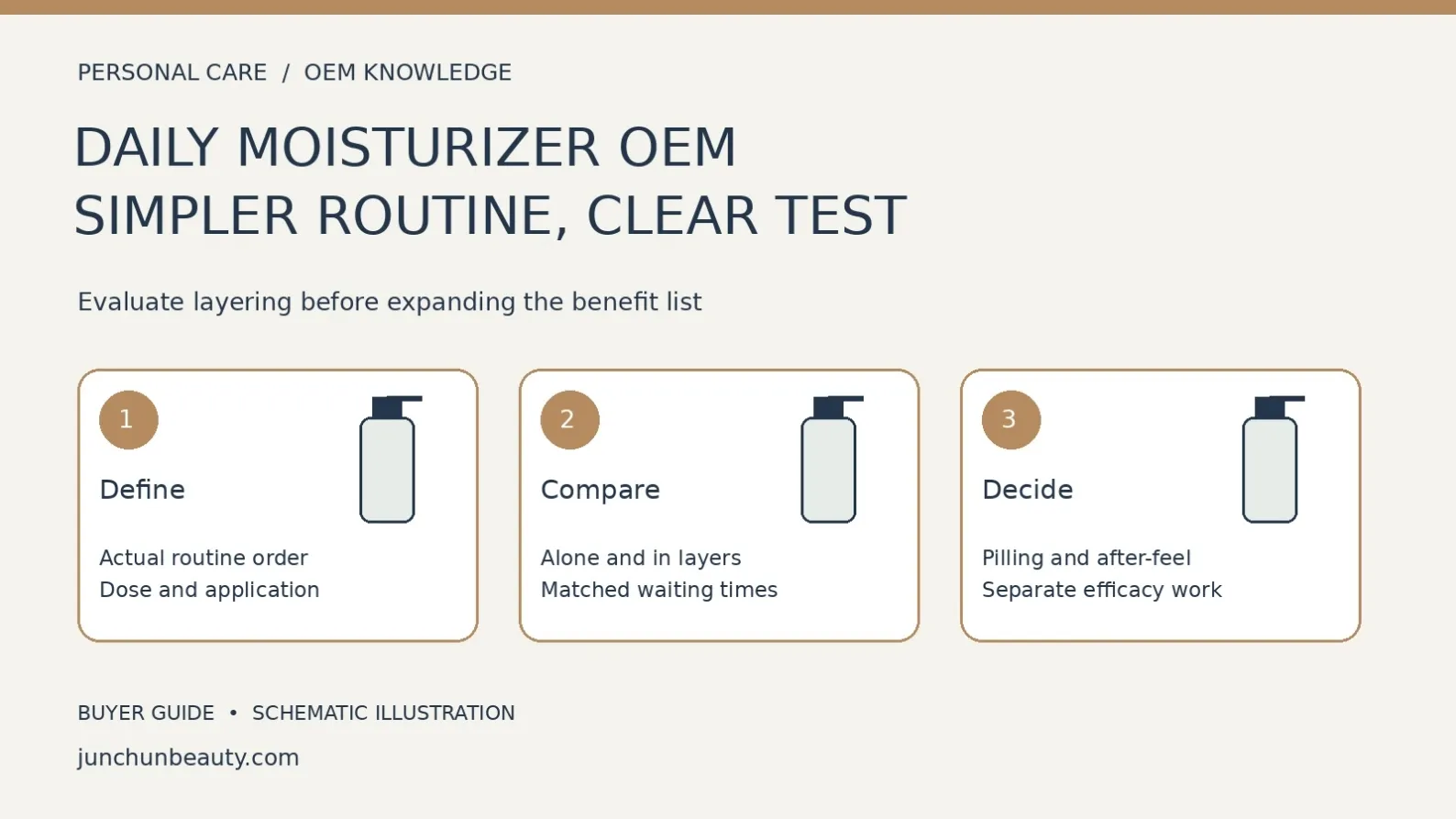
Choose a daily moisturizer for a simpler routine by testing the finished sample alone and with the products users will actually layer around it. Keep amount, order and waiting time defined, then record pilling, spreading and after-feel separately. A pleasant layered experience does not prove barrier repair, long-duration hydration or that the moisturizer replaces every other product in the routine.
The current simplification signal
On 7 October 2026, Beautyworld Dubai published an editorial discussing simpler routines and expectations that individual products do more. Organizer analysis, checked 7 October. It is a qualitative industry view, not proof that a particular moisturizer format has gained sales or that every customer wants fewer steps.
Our inference: a development opportunity may exist when a moisturizer fits the customer's real routine with fewer complications. Test that fit before adding a long list of promises. A short routine should still explain what each retained product contributes.
Define what simpler means for this customer
Ask which products are currently used, in what order and at what quantities. Record relevant expectations such as quick spreading, a comfortable finish or easy use before another day product. Avoid describing a multi-step routine as simplified solely because the moisturizer label carries several ingredient names.
Identify the step the new product is meant to replace. If it adds another layer without removing or improving any existing step, the convenience proposition needs refinement. The right comparison is the actual routine with and without the proposed product, not an isolated sample beside an unrelated benchmark.
Build a layering matrix that can be interpreted
| Evaluation condition | Keep recorded | Observation to review |
|---|---|---|
| Moisturizer alone | Dose, application and skin preparation | Spread and after-feel |
| Routine without the candidate | Existing product sequence | The user's current reference experience |
| Routine with the candidate | Same surrounding products and defined timing | Pilling, handling and comfort |
| A justified alternative sequence | What changed and why | Whether directions improve the practical result |
Any alternative sequence should remain consistent with the intended uses of the products involved. Do not treat arbitrary mixing in the palm as an approved product routine.
Distinguish pilling from efficacy
Record when visible rolling occurs: during spreading, after a pause or when applying another layer. Note the amount and handling. Describe the material seen rather than assigning a chemical cause without investigation.
Pilling can affect user experience, but its presence or absence does not measure moisturizing efficacy. Similarly, a rich or slippery feel does not establish a clinical endpoint. Keep cosmetic handling observations separate from evidence that supports a hydration-duration or barrier-related claim.
Cosmetics Europe's May 2008 efficacy guidance, checked 7 October 2026, provides older methodological context. Our layering matrix is a proposed purchasing screen, not a standardized clinical protocol or a finished claim-substantiation package.
Change one variable before changing the whole formula
If a combination pills, first confirm that the observation repeats under the stated routine. Review dose, application, waiting interval and surrounding product versions. A buyer should not require the formulator to remove an entire ingredient class after one uncontrolled comparison.
Send repeat observations, sample codes and the full routine to the supplier. The response may involve a different mature formula, revised instructions or custom work. Ask which changes require additional stability, packaging or performance assessment before they are accepted.
Use appropriate, reviewed samples for intended human evaluation. If a person reports irritation or another concerning reaction, stop their use and escalate the report. Routine compatibility does not establish safety for every skin condition or an all-sensitive-skin claim.
Evaluate the final dispenser and the product proposition together
Assess the moisturizer in its intended filled pack. The dispenser should help users apply a practical amount, not require guesswork. Compare first use and normal repeated handling. A jar, standard pump and airless pack introduce different instructions and procurement scopes; do not assume that one sample result approves all three.
For a selected mature formula, confirm the available stock packaging and applicable quantity. If differentiation depends on a custom texture, fragrance or claim, request an explicit development and evidence budget. Review skincare OEM options to identify routes that match the proposition.
Retain a concise approval file
Record formula version, pack, directions, target routine, evaluation results and the evidence behind each claim. Explain which results are sensory observations and which come from separately commissioned studies. If the formula or surrounding routine changes, revisit the relevant conclusions.
A focused moisturizer can be a useful supporting category for a hair-care-led brand, but it should meet a real buyer need. Avoid adding it simply to make a catalogue look broader. Make the inquiry invitation proportionate to the technical decision the article helps buyers make.
For related sampling, review the daily lightweight moisturizer development option. Confirm the sample, pack and claim scope; a catalogue concept does not establish layering results in the intended routine.
Buyer FAQ
Does no visible pilling establish barrier repair?
No. Layering performance and barrier-related efficacy are different endpoints.
Can one successful combination prove compatibility with every routine?
No. Conclusions apply to the products, versions and conditions evaluated.
Should a simpler-routine product carry more benefit claims?
Not necessarily. Retain claims that are useful, supported and consistent with the intended use.
Can a pack change affect application experience?
Yes. Evaluate dispensing and practical dose in the proposed final pack.
Project discussion
Through Contact, send the target users, proposed shorter routine, surrounding products, preferred dispenser, volume and claim priorities. Request an OEM proposal separating layering assessment, formula development, package evaluation and any commissioned efficacy work.