Heat-Protection Leave-In OEM: What a Temperature Claim Report Must Identify
Review heat-protection leave-in OEM evidence by formula, dose, hair type, temperature and exposure. Match claim wording to a suitable finished-product test report.
Direct answer
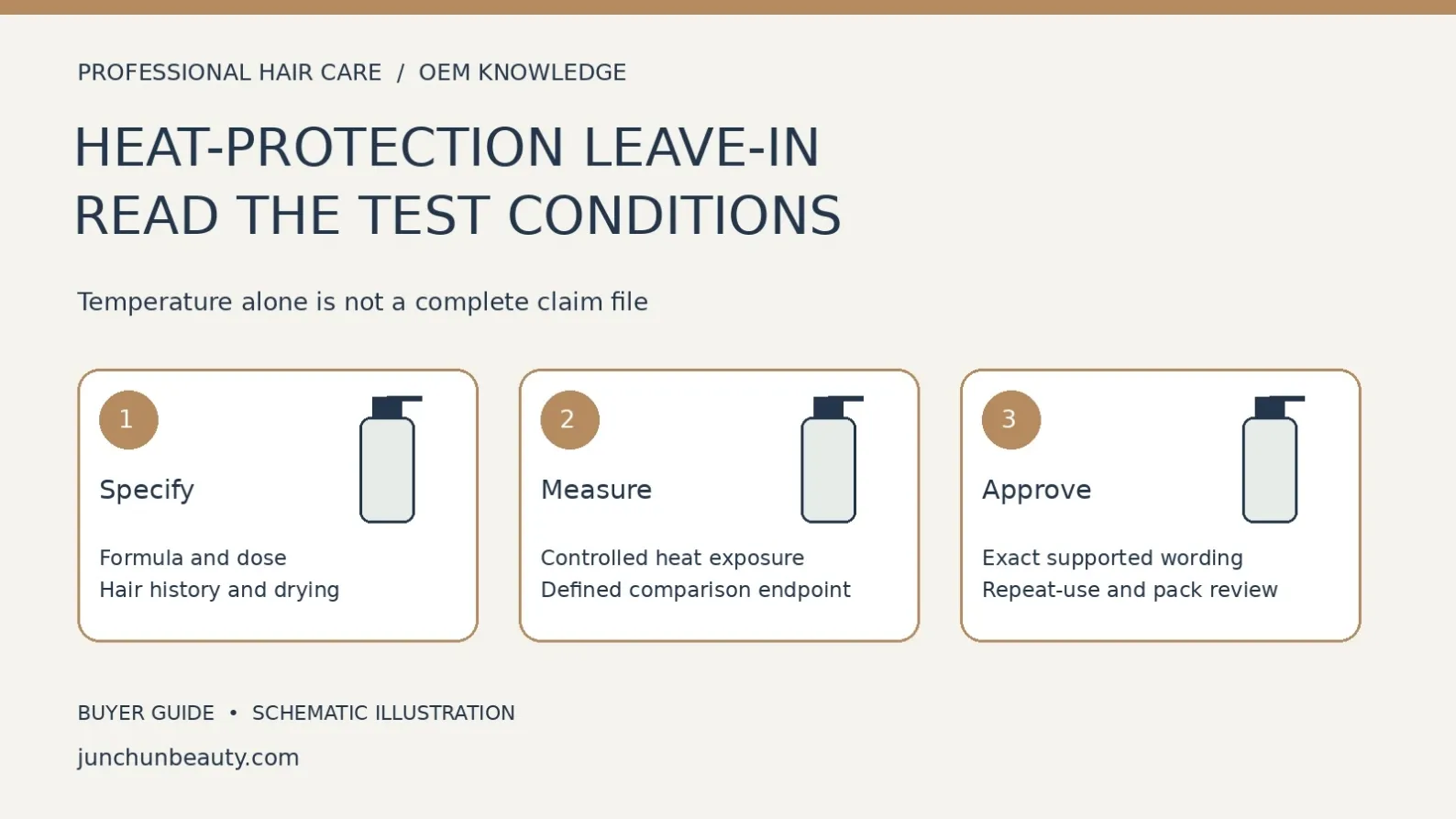
A useful heat-protection report identifies the exact formula, application dose, hair substrate, drying conditions, heating procedure, comparator and measured endpoint. The temperature printed on a device is only one condition. Approve a numeric claim only when the method and result support that wording on the finished product used as directed.
Sourcing context and evidence limits
The organizer's regional hair-care editorial, dated 16 June 2026 and checked on 8 October, discusses Middle Eastern interest in care associated with heat and dryness. This is contextual editorial analysis, not a new quantified demand signal.
Junchun's current leave-in product page, rechecked on 8 October, calls for defining the temperature, dose and method for numerical heat claims. The article below expands that procurement question. It does not report completed testing or assign a protection temperature to an unapproved formula.
Turn a marketing number into a technical question
A buyer may request a high temperature because comparable retail products use prominent numbers. That is a starting brief, not a result. Ask what benefit the claim is intended to communicate: reduced measured damage under a protocol, better handling after styling or another defined outcome.
Specify the intended tool and routine. Blow-drying, repeated flat-iron passes and curling can involve different contact, heat and moisture conditions. A report designed for one procedure should not be presented as proof of all heat-styling situations.
Review the core fields together
| Report field | Why it matters | Question for the supplier |
|---|---|---|
| Formula version | A reformulation changes the tested product | Does the report identify the proposed production formula? |
| Application | Dose and distribution affect exposure | Does it match the intended directions? |
| Hair substrate | Hair history can influence the outcome | Which treated or untreated groups were tested? |
| Heat procedure | Set-point alone does not describe exposure | What tool, contact, passes and drying state were used? |
| Comparator and endpoint | These define what improvement means | What was measured and against which condition? |
The laboratory should select an appropriate method with controls and replicates. Ask for the method's limitations and reporting uncertainty. A favorable photograph without a defined comparison is not enough for a numerical protection statement.
Separate thermal evidence from cosmetic finish
A leave-in can give slip, shine or a smoother appearance without establishing the advertised thermal endpoint. Screen those cosmetic outcomes because they matter to customers, but keep them in a separate section of the approval file.
Likewise, favorable combing after heat exposure may be relevant to a particular endpoint but does not automatically demonstrate every possible meaning of “damage protection.” Make the connection between method, result and exact phrase explicit. Do not claim zero damage or guaranteed protection under any styling technique.
Match the report to directions and the applicator
A controlled-dose pump, fluid milk and fine-mist spray may distribute different amounts. If the laboratory applied a weighed dose to a tress, evaluate whether consumer directions can reasonably produce the intended coverage. Keep the approved pack and applicator in the sample record.
Check whether directions require application to damp or dry hair, a waiting period or another step. The final directions must be supported and reviewed by the responsible product team. A change in format from milk to spray is more than a visual packaging change and can require new delivery and claim evaluation.
Plan repeat use and relevant hair groups
Choose hair groups that reflect the intended audience and retain their separate outcomes. Do not use a test on one untreated tress type to imply universal performance on bleached hair, extensions and every curl pattern. Define the groups the evidence can reasonably cover.
Assess the intended routine over appropriate repeated-use conditions with the technical team. Record buildup, dry handling and compatibility with accompanying products. A leave-in that supports a laboratory endpoint but feels unacceptable at the tested dose may need reformulation or clearer instructions before commercialization.
Approve wording before printing
Have technical and market reviewers align the exact claim, directions and evidence. Keep the approved formula, reference sample, pack specification and claim-support report connected. List changes that trigger review: dose, fragrance, conditioning system, package and intended use can all matter.
Confirm development and testing costs separately from unit production costs. Selected mature-formula and stock-pack routes may be possible at lower quantities; a new numeric heat claim can still require additional work. Budget for that work before fixing a launch date or artwork deadline.
Buyer FAQ
Does one high-temperature test prove protection in every styling routine?
No. Evidence applies to its conditions and supported wording; tool, exposure and hair differences must be assessed.
Can an ingredient brochure supply the final product's temperature claim?
No. Finished-product evidence and the intended application protocol are needed.
Is shine after styling proof of thermal protection?
Not by itself. Appearance and a defined thermal-damage endpoint are separate outcomes.
Can a pump sample report be reused for a spray version?
Only after qualified review confirms relevance. Formula changes and different dose delivery may require further testing.
Project discussion
Explore the leave-in development reference, professional treatment route and OEM/ODM options. Send your tool, hair group, format, proposed wording, target market and quantity through Contact. Request a claim-support scope before approving a numerical statement.