Hard-Water Shampoo OEM: Separate Chelation Evidence from Cleansing and Conditioning
Evaluate hard-water shampoo OEM with controlled water conditions, defined mineral endpoints and hair-feel checks. Separate ingredient chelation from product proof.
Direct answer
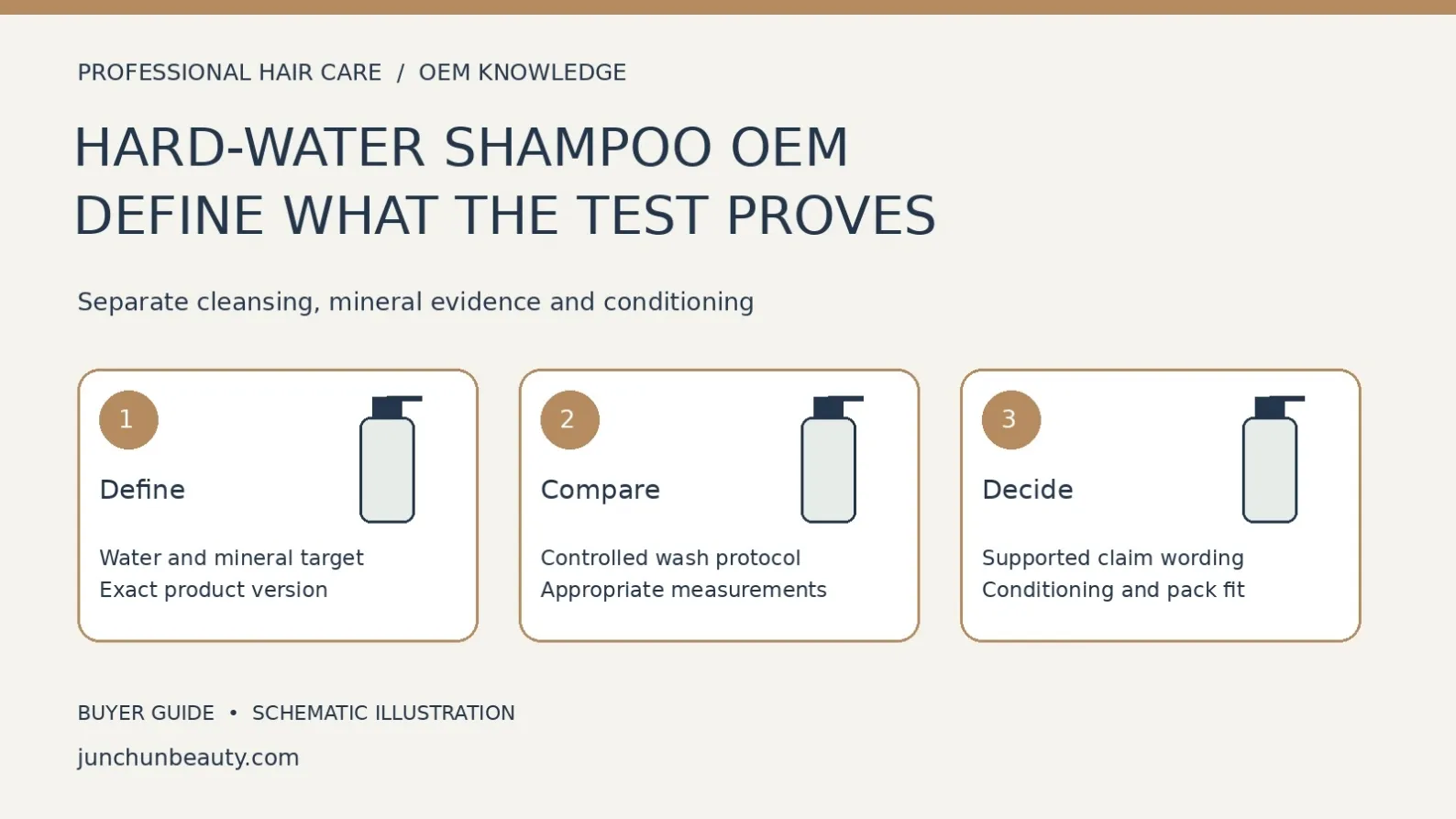
Request a defined water condition, mineral target, controlled wash method and suitable finished-product measurements. Record cleansing and conditioning separately from mineral-removal evidence. A chelating ingredient in the INCI supports a formulation direction, but it does not establish a universal percentage of metal removal or performance on every type of hair.
What is verified, and what is background?
Nouryon's personal-care technical bulletin, dated August 2021 and accessed on 8 October 2026, identifies Tetrasodium Glutamate Diacetate as a chelating ingredient and describes hard-water management applications. This is primary ingredient information, not a new October launch or a finished-shampoo study.
Junchun's current hard-water shampoo page, checked on the same date, provides a GLDA-based OEM concept with project-specific performance and test planning. Its existence confirms a development route; it does not substitute for evidence on your approved product.
Define the exact claim before designing the screen
Ask whether the target is cleansing in mineral-rich water, reducing measured deposits on hair or improving the feel of a routine used with hard water. These objectives can require different evidence. A foam observation in hard water is not a measurement of metal remaining on a hair fiber.
Specify the relevant mineral or metal species, water source or characterized test solution, target hair group and intended frequency. Do not treat every “hard-water” complaint as identical. Rough feel can also reflect hair history, styling residue and the conditioning step, so the purchase brief should identify those possible influences.
Build a test matrix with the laboratory
| Question | Control or record to discuss | Interpretation boundary |
|---|---|---|
| Does water change wash behavior? | Characterized water conditions and consistent protocol | Does not alone prove deposit removal |
| Does treatment change a mineral endpoint? | Suitable analytical method and untreated or comparator samples | Supports only the measured endpoint |
| How does hair feel after washing? | Matched hair groups and separate conditioning conditions | Sensory improvement is not proof of a mechanism |
| Is the pack usable? | Exact filled bottle, pump and viscosity conditions | Pack approval is separate from efficacy |
Have a qualified laboratory choose a method appropriate to the target claim, including sampling, replicates and analytical limitations. Agree in advance whether results will describe the shampoo alone or a multi-step system. Do not use a mask-assisted result to imply that the shampoo alone delivers the same outcome.
Keep conditions visible in the report
Record formula version, dilution or dose, exposure time, rinse procedure, water characterization and hair history. If preloading hair with a model deposit, document that preparation and distinguish it from naturally exposed consumer hair. The method's relevance matters as much as a favorable final number.
A meaningful report should identify the comparator. A result versus water-only washing answers a different question from a comparison with a conventional shampoo. Ask which uncertainty remains and whether the test can support the intended consumer wording rather than only a laboratory statement.
Screen conditioning as its own purchasing outcome
Compare wet detangling, dry feel, appearance and repeat-use experience under the intended routine. A strong cleanse that leaves unacceptable handling may not fit a regular-use retail product. Conversely, a pleasant finish cannot by itself substantiate chelation.
Evaluate the proposed mask or leave-in separately before combining the routine. This lets the buyer see which step contributes to the result and whether users can follow the instructions consistently. Keep color-treated, lightened and untreated hair results separate where the project targets those groups.
Convert evidence into a supply decision
Use wording limited to the exact approved formula and demonstrated endpoint. Avoid “removes all heavy metals,” “repairs every type of damage” or a numerical result carried over from a raw-material brochure. Have the intended-market reviewer assess the final label and supporting file.
Confirm that stability, microbiological evaluation, package compatibility and transport work cover the selected product. Custom ingredient levels, fragrance or a viscosity change may alter the review scope. An available stock bottle and mature formula may simplify a selected low-MOQ route, but testing and destination requirements remain project-specific.
Buyer FAQ
Does GLDA in the INCI prove mineral removal from hair?
No. It identifies an ingredient; the finished-product claim requires a suitable method and evidence.
Is salt-free the same as chelating?
No. Define the formulation meaning of salt-free separately. Chelation concerns interaction with specified metal ions.
Can good foam prove the hair is free of mineral deposits?
No. Foam behavior and a mineral measurement answer different questions.
Should the shampoo and mask be tested together only?
Test according to the intended claims. Separate-step comparisons help identify contributions before assessing the combined routine.
Project discussion
Review the hard-water shampoo, professional treatment and OEM/ODM routes. Send your target country, water issue, channel, capacity, quantity and intended wording through Contact. Request a defined sample and testing scope before approving the supply program.