Salon Shampoo OEM: Compare Cost per Wash Before Choosing a Backbar Pack
Compare salon shampoo OEM by usable fill, verified application dose and cost per wash. Assess backbar packs and reorder economics beyond the headline bottle price.
Direct answer
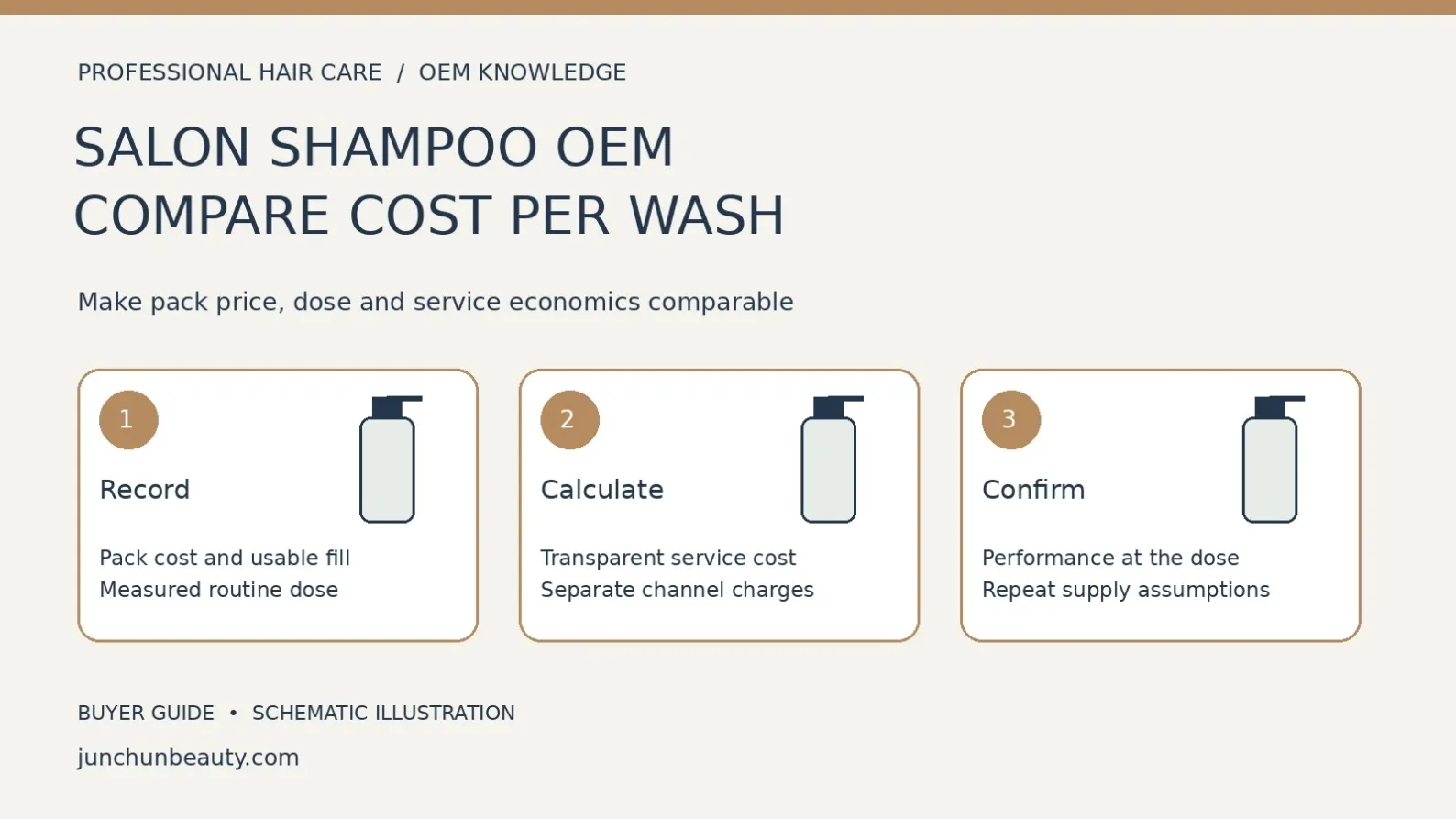
Compare shampoo offers by cost per supported service, using usable fill and a realistic application dose. Check cleansing and hair feel at that dose before choosing a cheaper bottle or larger pack. Keep freight, channel margins and other costs separate so the calculation remains understandable and comparable.
Why headline prices need context
Amazon's October promotion page, checked on 8 October 2026, lists hair-care offers within its 6–7 October US promotion. This is a current example of price-led retail presentation. It does not supply OEM shampoo quotations or show a salon's actual service cost.
The procurement inference is straightforward: a visible bottle price is an incomplete comparison. A salon distributor needs to know the routine dose, usable product, performance, pack losses and repeat-supply assumptions behind its own economics.
Start with a comparable service definition
Define what counts as one service: a single wash, a two-wash protocol or another documented salon process. Identify the intended hair length, density and soil or styling-residue conditions. Keep exceptionally demanding services visible rather than hiding them inside an average.
Agree a realistic dose with the salon team and supplier. A lower dose is commercially useful only if it gives the required cleanse and acceptable hair feel under the protocol. Do not call a formula concentrated merely because the supplier recommends using less.
Calculate using explicit units
For a volume-based model, use usable milliliters and milliliters per service. If weighing dose in grams, determine the relevant density before combining those readings with a volume-labelled pack. Avoid quietly treating grams and milliliters as interchangeable.
The calculation is: product cost per service equals the allocated pack cost divided by the number of complete services supported by usable fill. Usable fill should account for a documented amount remaining in the package under normal use. Define whether the allocated cost includes freight or only the product and pack.
Hypothetical comparison, not a quotation
| Input | Offer A | Offer B |
|---|---|---|
| Pack size | 1,000 ml | 1,000 ml |
| Illustrative pack cost | US$8 | US$10 |
| Illustrative usable fill | 960 ml | 970 ml |
| Assumed validated dose per service | 8 ml | 6 ml |
| Complete services | 120 | 161 |
| Product cost per complete service | About US$0.067 | About US$0.062 |
These numbers are invented solely to demonstrate arithmetic, not Junchun prices or measured dose and loss data. Offer B appears lower per service only if its assumed smaller dose actually delivers the required result. Replace every input with verified project data before purchasing.
Validate delivery and pack loss
Measure output using the proposed pump and filled formula under a documented procedure. Record priming, repeat actuation and performance as fill level falls. If viscosity or component design changes, check whether dose delivery remains consistent.
Observe normal end-of-pack handling. Include residual product and practical access without encouraging unsafe decanting or improvised handling. A nominal one-liter bottle does not automatically yield every labelled milliliter as convenient service dose.
Compare the pack in a real backbar workflow: shelf or station fit, wet-hand handling, readable identification and manageable storage. A large container may reduce some costs while increasing handling difficulty, slower turnover or exposure after opening. The right size follows the use pattern, not a universal bigger-is-better rule.
Add channel costs without hiding the formula cost
Keep production price, freight, importer expenses, distributor margin and salon economics in separate lines. State the currency, Incoterm and quote validity. A changing exchange rate or freight charge can alter the commercial result without changing formula performance.
Model a base order and a reorder rather than assuming the launch discount continues indefinitely. Ask about stock-pack availability, price validity, component substitutions and repeat lead-time assumptions. If a professional size requires a different MOQ, evaluate inventory risk against the service-cost benefit.
Choose using both economics and performance
A useful approval record combines dose evidence, washing observations, filled-pack checks and a clear quote. Keep target-market safety, stability, microbiological and labeling work within the project scope; a cost calculation does not replace them.
Use a smaller initial range when evidence is incomplete. A shampoo may be paired with a mask or leave-in, but assess each step's service role and margin rather than applying one set-wide assumption. Plan replenishment against actual usage and stock, then revise the model with experience.
Buyer FAQ
Is the cheapest one-liter bottle the lowest-cost choice?
Not always. Dose, usable fill, performance, included costs and pack handling can change the result.
Does recommending a small dose prove concentration?
No. The required performance at that dose must be demonstrated under a suitable use protocol.
Can grams be inserted into a milliliter calculation directly?
No. Keep units consistent or use an appropriate density conversion for the formula.
Are the example prices company quotations?
No. They are hypothetical arithmetic inputs; actual prices and specifications require project review.
Project discussion
Review the catalogue, hard-water shampoo concept where relevant, and OEM/ODM routes. Send your market, salon routine, size, estimated annual usage and order quantity through Contact for a scope-based quote and dose-evaluation discussion.