Beauty in the Motherland 2026: Build a Channel-Specific Hair-Care Distributor Pilot
Plan a hair-care distributor pilot around Beauty in the Motherland 2026 by separating salon and retail needs, trial quantities, feedback and reorder evidence.
Direct answer
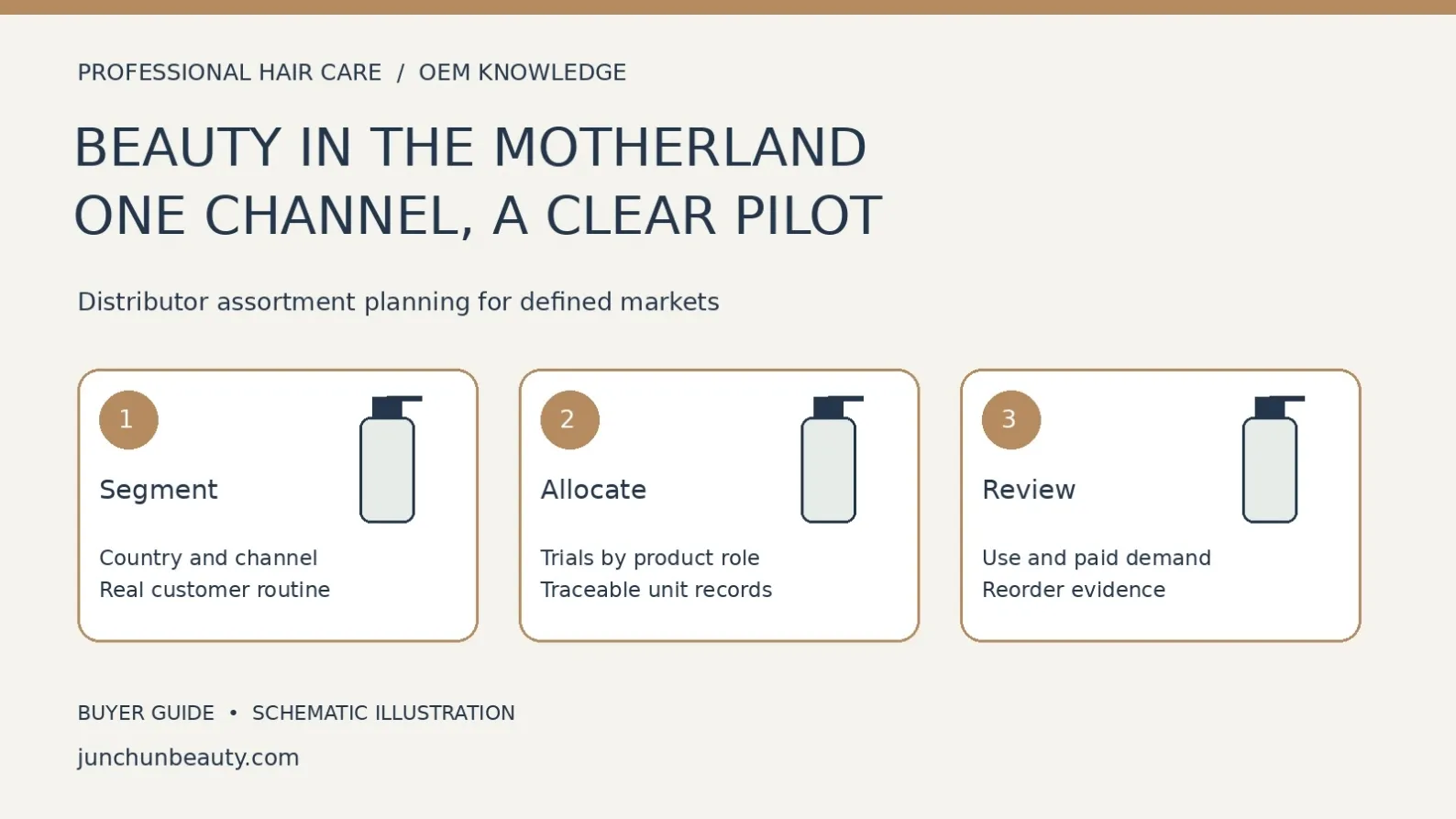
Build a hair-care distributor pilot around one defined country, channel and customer routine before selecting a broad OEM assortment. Separate salon-service needs from home retail, allocate trial units by product role and collect product-level feedback alongside paid demand. Exhibition interest can help prioritize conversations, but it cannot determine a launch quantity or prove that one assortment fits several African markets.
What is known about the event
Beauty in the Motherland's organizer lists 5–7 October 2026, at Eko Convention Center, Victoria Island, Lagos. Official page, checked 7 October 2026. We have not verified exhibition order values or conversion rates. This article is an independent distributor-planning guide, not a statement of Junchun attendance.
Procurement inference: the most useful follow-up from a show may be a narrower, better documented assortment brief. A distributor who can explain its channel and stock movement is easier to support than one requesting a large collection without a product-level plan.
Define the channel before the hero ingredient
Choose the country or initial selling territory, the customer type and the distribution route. Within salon supply, distinguish backbar use from take-home retail. Within retail, understand whether staff provide instructions or customers largely choose unaided.
Describe the routine in practical terms: wash frequency, styling steps, relevant treatment history and preferred format. Avoid assigning the same needs to everyone with textured hair or using climate as a complete explanation for product preference. Test those assumptions with buyers and suitable product evaluation.
A relevant African-market hair and body collection can provide development directions, but it is not proof that every line belongs in the first order. Select a focused proposition before extending categories.
Compare channels with separate questions
| Channel | Primary pilot question | Useful operational measure |
|---|---|---|
| Salon service | Can staff use the product consistently? | Dose, usable content and documented service feedback |
| Salon retail | Do customers understand the home routine? | Instructions, paid sales and subsequent use feedback |
| General retail | Is the product role clear without specialist advice? | Customer questions, returns reasons and sell-through |
| Distributor resale | Can downstream buyers support the same proposition? | Repeat orders by customer and SKU, not total contacts |
Allocate units so the pilot remains interpretable
Record how many units go to paid sale, samples, staff training, reference stock and replacements. Keep those categories separate. A product given away to twenty contacts has not generated twenty customers.
Track product and packaging versions with the units sent out. If a fragrance or closure changes midway through a pilot, do not combine all feedback as if it came from the same product. Record country, channel and applicable directions so the supplier can identify what needs adjustment.
Selected mature formulas and in-stock bottles may support orders from 100 pieces per SKU, subject to confirmation. Professional sizes, custom formula work or special components need their own scope. A pilot comprising several SKUs can still create multiple inventory commitments; review the budget per SKU rather than quoting only a total.
Keep commercial observations separate from product observations
Paid sell-through helps assess channel demand, while use feedback helps assess product fit. Neither alone is sufficient for a production expansion. A discounted bundle may move quickly even when one product is rarely used. A highly liked free sample may not sell at the intended retail price.
Record the effective selling conditions and compare like with like. Do not assume that responses from a show, a salon and a social campaign have the same commercial value. Ask what buyers paid, which SKU they used and what they intend to reorder.
Build review timing around consumption. A product used weekly will not create a reliable repeat-purchase signal on the same timetable as a frequently used cleanser. Define which early indicators are provisional and which need more time.
Specify market-entry and supply responsibilities
Identify who reviews local labeling, documentation and market-entry requirements before sale. Request applicable product information and agree the supplier's scope. Do not infer that an exhibition's location establishes regulatory acceptability in Nigeria or another destination.
Confirm quote assumptions, pack availability, shipping scope and approved substitutions. A future reorder should reference the same formula and component specification unless changes have been reviewed. Review additional product options only when the initial channel evidence supports an extension.
Buyer FAQ
Can the same first assortment serve every African market?
Not without assessment. Country, channel, customer routines and purchasing conditions vary.
Are sample placements equivalent to paid sell-through?
No. Track free samples, sales and replacements separately.
Should a fast-selling bundle justify reordering every SKU?
No. Assess use, demand and contribution for each product rather than assuming equal value.
Does event participation guarantee local product approval?
No. Confirm applicable market-entry responsibilities independently for the destination.
Project discussion
Through Contact, send the intended country, channel, customer routine, first assortment, quantity per SKU and packaging needs. Request an OEM proposal that ties trial allocation, product approval, documentation and replenishment to a clear distributor pilot.