Beautyworld Dubai 2026: Validate Salon Repeatability Before Ordering Hair Care OEM
Build a salon repeatability plan around Beautyworld Dubai 2026 with operator training, controlled product doses, routine comparisons and OEM approval gates.
Direct answer
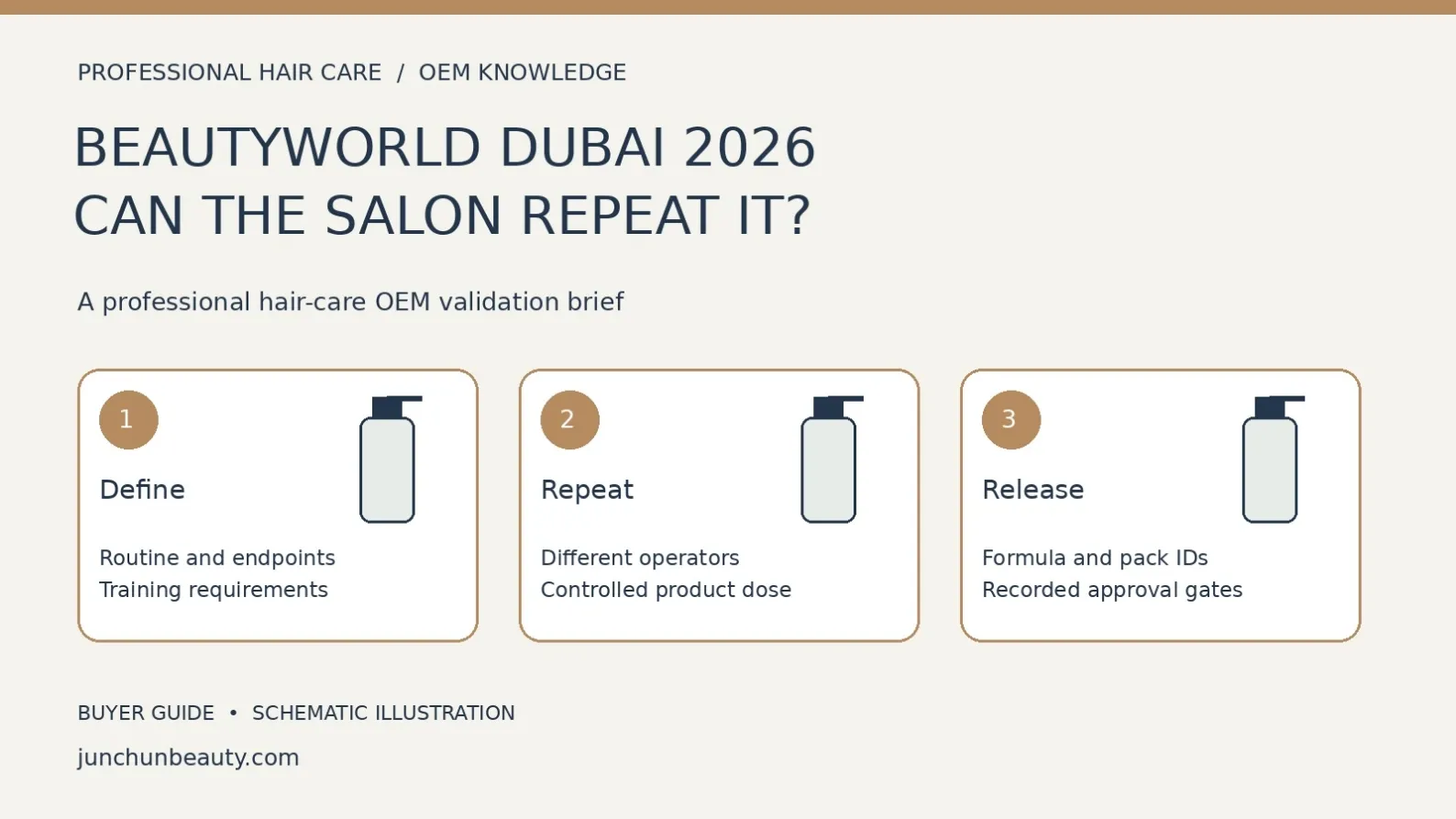
Before ordering a professional hair-care OEM product inspired by a demonstration, confirm that the intended salon team can repeat the routine using ordinary training, the approved formula and the proposed pack. Define product dose, tools and assessment criteria, then record variation across operators. A strong stage result is a concept signal; consistent, documented service performance is a more useful basis for a purchasing decision.
The verified show signal
The beautyLIVE programme at Beautyworld Dubai lists 7 October 2026 demonstrations by Josh Lamonaca, Mounir, Shark Beauty and KERALOOK. Organizer agenda, checked 7 October. That verifies scheduled professional education, not a finished-product performance comparison or Junchun participation.
Our procurement interpretation: professional brands can use the programme to identify questions worth testing. The useful question is often whether a salon can deliver the intended result consistently, rather than whether one expert can create an attractive finish once.
Separate the service protocol from the product specification
Write the service in order: preparation, product application, processing or styling, finishing and assessment. Record the intended hair group and relevant treatment history. List all products involved, including any cleanser or conditioner before the proposed OEM treatment.
The product specification should separately identify formula version, application areas, dose guidance, packaging and proposed claims. A routine that depends on several unnamed products cannot support a fair purchasing comparison for one new SKU.
Ask what level of training is needed. If the result relies on specialist techniques, consider whether the intended channel can teach and maintain those techniques. That training requirement belongs in the commercial brief, not in an informal note after samples have been approved.
Use a service-to-product approval matrix
| Approval layer | Record before evaluation | Evidence for the next decision |
|---|---|---|
| Formula | Code, intended use and relevant hair group | Suitable samples and agreed product assessments |
| Service | Sequence, dose and tool conditions | Comparable results under the defined routine |
| Operator | Training and who performed each trial | Whether the routine is repeatable by the target team |
| Pack | Bottle, closure and delivered amount | Practical dispensing during normal service |
| Commercial | Quantity, scope and available components | A feasible quote and repeat-order route |
Plan operator comparisons without inventing a universal pass rate
Choose representative trained operators and document their starting instructions. Use coded samples or a relevant benchmark where practical. Keep the hair material, treatment routine and assessment timing comparable. Record exceptions and explain why a result was excluded, if it was.
A supplier and buyer should agree study design and interpretation with qualified personnel. Cosmetics Europe's May 2008 efficacy guidance, checked 7 October 2026, provides older methodological context on protocols and evaluation. The matrix here is our proposed procurement approach, not a prescribed laboratory method.
Do not claim that a small internal salon trial represents every hair type or establishes a numerical reduction in damage. Record what was actually evaluated and separate expert scoring from customer preference. If the primary claim needs instrumental or other specialized evidence, include that work in the development quotation.
Measure the operational burden as well as the finish
Record preparation effort, application control, dispensing interruptions and clarity of directions. These observations help distinguish a formula that is attractive in demonstration from one that fits the salon's actual workflow.
For a professional pack, assess dispensing during repeated services rather than only on the first use. Check whether staff can apply the agreed amount without guesswork. A larger bottle does not automatically deliver lower cost per service: calculate using the defined dose and usable content, then state the assumptions.
Consider how the home-care counterpart fits the salon result. Its directions should be practical for ordinary users, and its benefit should be supported by evidence relevant to that use. Do not assume that the same instruction sheet works for both channels.
Convert the approved protocol into an OEM release file
Retain the approved formula sample, pack reference, instructions, artwork version, test records and open questions. Confirm who signs off each item. A formulation revision, new fragrance or component substitution may affect earlier observations; agree which checks need repeating.
Professional formats and custom development require project-specific quantities and timelines. Selected mature formulas in in-stock bottles may support lower starting quantities, but do not treat that route as a blanket promise for every salon pack or custom service system.
Review OEM product options and request a quotation that separates formula, packaging, decoration, evaluation and logistics. A price comparison is meaningful only when the compared scopes match.
For related sampling, review the leave-in milk development option. Treat the format as a starting point for a service-specific sample brief, with benefits and evidence confirmed for the final formula.
Buyer FAQ
Does a beautyLIVE demonstration prove a formula's clinical efficacy?
No. It is professional education; specific performance claims need relevant finished-product evidence.
Should operator variation be ignored if the best result is excellent?
No. The target salon team must be able to reproduce the intended routine with realistic training.
Is cost per bottle the same as cost per service?
No. Account for actual dose, usable content and the complete service scope.
Can a home-care SKU use the same claims as a salon treatment?
Only when the evidence and directions support the home-use conditions being advertised.
Project discussion
Through Contact, send the target salons, hair group, service steps, pack formats, proposed claims and volume. Request a development proposal linking sample evaluation, operator training, packaging approval and the final production release.