Hydrating Hair-Care System OEM: Test the Incremental Value of Each Routine Step
Evaluate a hydrating hair-care OEM system by comparing each added routine step. Control the substrate and directions before attributing a benefit to every SKU.
Direct answer
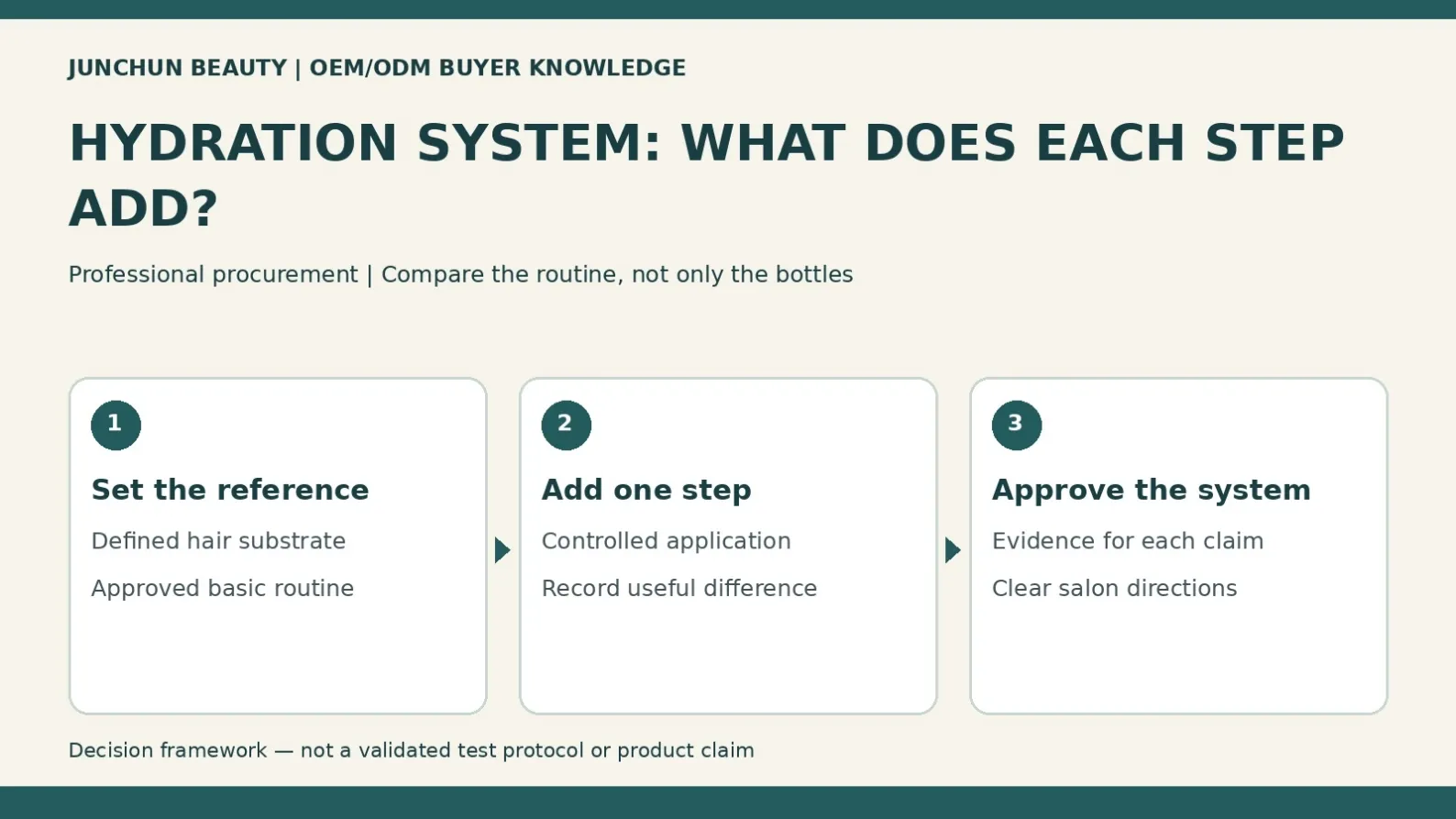
Evaluate a hydration system by comparing a defined reference routine with planned added steps, while keeping hair substrate, application and drying conditions consistent. Ask what useful difference the conditioner or leave-in adds. Do not assume every bottle is essential or assign a whole-system result to an individual product without supporting evidence.
Current ranges make the system question relevant
Goldwell’s official Pure Hydration page presents the range as a hydration proposition Goldwell official Pure Hydration range (Accessed 10 October 2026; page publication date not stated). A dated October launch roundup also highlights the range PEOPLE October launch roundup (9 October 2026). These signals support investigating routine design. They do not establish that a three-product OEM set will outperform a simpler routine or sell better in a particular market.
Kao’s public LinkedIn relaunch post provides older professional-brand context Kao EMEA & Americas LinkedIn relaunch post (Accessed 10 October 2026; displayed relative age 2w, exact publication date unverified). The page checked today displays a relative age of two weeks, so it is not treated as a fresh last-seven-days event. Its value here is context for coordinated product communication, not proof of demand or efficacy for a proposed Junchun system.
Define a reference that answers the buying question
Start with the intended professional or home routine, hair substrate and current problem. A distributor replacing a salon backbar system needs a different comparison from a brand adding a leave-in to an established collection. Record treatment history and condition, and have the technical team choose a suitable design and safe procedure.
If the question is the contribution of a leave-in, keep the underlying wash-and-condition steps fixed. If the conditioner is the question, agree an appropriate reference routine with the technical team. Do not remove a normal protective or handling step simply to create a dramatic result. The comparison must be relevant and responsibly designed.
Add one routine variable at a time where practical
Use the agreed application amount and directions, and record rinse conditions, dwell time and drying method. Keep the comparison sequence visible. When more than one variable changes, report the result as a comparison of routines rather than the isolated effect of one ingredient or one SKU.
For each added step, record its intended contribution: easier distribution, acceptable wet handling, a desired dry finish or another defined cosmetic observation. Separate those descriptions from quantitative performance claims. If the team proposes an instrumental method, agree its substrate, comparison, repeatability and interpretation before using the results in marketing.
Check whether the full routine adds unwanted complexity
A system may perform well when an expert uses precise amounts, yet be difficult to reproduce at home. Include the handling time and instructions in the buying record. Ask which steps are everyday, occasional or optional. A distributor should be able to explain the product role without telling every customer to use every bottle every time.
Observe whether added steps create unwanted coating, inconsistent drying or a finish outside the target brief. These observations can justify changing directions, selecting another candidate or simplifying the collection. They do not mean the formula is inherently poor. The question is whether the complete routine serves the buyer’s intended customer.
Map claims to the evidence actually obtained
If the evidence concerns the shampoo-and-conditioner pair, keep the claim tied to that combination and its conditions. If a leave-in changes the finish, do not assign the full difference to the shampoo. Technical and market reviewers should decide which claim wording the finished configuration supports.
Avoid borrowing a temperature-protection, breakage or hydration-duration number from a branded system. Ingredient inclusion, matching fragrance and coordinated packaging do not establish equivalent performance. Each proposed claim requires a relevant evidence pathway. Keep preliminary screening records separate from approved substantiation and release documents.
Order a system that can be reproduced
The final order should identify each formula version, pack, dispensing behavior and directions, together with any approved combination wording. Confirm minimum quantities separately for every SKU and format. A low-MOQ existing product does not automatically extend to a complete custom range, professional size or printed component.
Provide salons with a clear routine card and a record of optional steps. Agree how future changes will be reviewed, including fragrance, pack and formula substitutions. The best system decision explains why each included SKU has a useful role and how the customer can reproduce the approved experience without unnecessary complexity.
Sources and evidence limits
- Goldwell official Pure Hydration range — Accessed 10 October 2026; page publication date not stated. Brand product positioning, not sales data.
- PEOPLE October launch roundup — 9 October 2026. Recent editorial visibility, not independent efficacy or demand evidence.
- Kao EMEA & Americas LinkedIn relaunch post — Accessed 10 October 2026; displayed relative age 2w, exact publication date unverified. Older relaunch context; not a last-seven-days sales signal.
Buyer FAQ
Does a hydration range need three products?
Not necessarily. Choose the number of steps from routine evidence, buyer needs and feasible supply rather than range appearance.
Can I assign a system result to its shampoo alone?
Only if evidence supports that individual claim. Keep combination results tied to the tested routine and conditions.
Should every step be used at every wash?
Define the approved routine and optional steps for the target users. Do not assume one schedule suits all customers.
Does coordinated packaging prove product compatibility?
No. Evaluate the finished formulas and routine, while separately reviewing packaging, stability and release requirements.
Related product routes and project contact
- Explore textured-hair leave-in milk OEM
- Review OEM/ODM development solutions
- Browse professional hair and body product routes
Contact the Junchun OEM/ODM team: Share the salon or retail routine, current product references, target hair substrates, required claims and proposed SKU volumes for a system-evaluation brief. Business email: info@junchunbeauty.com.