After Beautyworld Dubai 2026: Make Hair-Care OEM Salon Trials Repeatable
Turn post-Dubai hair-care OEM interest into repeatable salon trials. Define the routine, operator instructions, comparisons and evidence before approving supply.
Direct answer
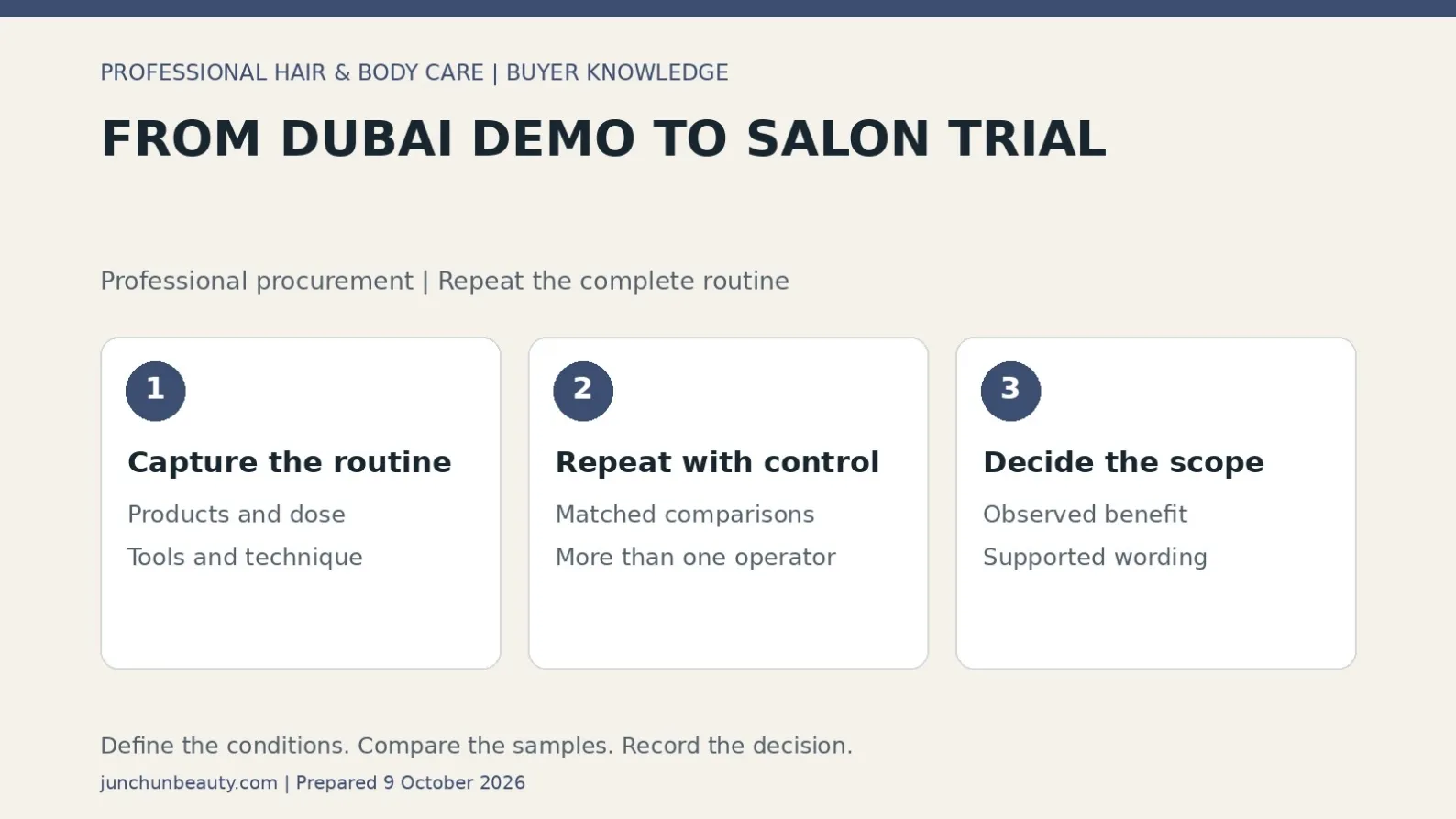
Translate the demonstration into a written routine that identifies every product, dose, tool and operator step. Repeat it on relevant hair under documented conditions and compare it with an appropriate reference. Approve the commercial product and wording only after the routine can be reproduced; a stage result alone does not establish finished-product efficacy.
What the organizer confirms
Beautyworld Dubai’s homepage, accessed on 9 October 2026, confirms that the 2026 edition has closed. Its beautyLIVE programme lists live hair education across 6–8 October. Neither source confirms Junchun’s attendance or product results.
The professional value of a demonstration is the opportunity to see a routine. Its procurement limitation is that the visible outcome can depend on preparation, section size, tools, skill and several products. A buyer who orders only one item should establish which part of the result that item is expected to provide.
Reconstruct the full service before selecting a hero product
Record the starting hair condition, wash or preparation step, product sequence, doses, application zones, processing intervals, tool settings and finishing technique. Identify whether the sample was used alone or with another treatment. Note which steps were described and which remain unknown.
Ask the supplier to separate the proposed product benefit from the effect of the complete service. If a display combines conditioning and a heat-styled finish, do not attribute the whole appearance change to conditioning alone. Request a technical explanation of which comparisons could reasonably investigate the proposed benefit.
Build a repeatability brief
| Variable | Record before the trial | Procurement consequence |
|---|---|---|
| Hair and prior treatment | Relevant type, damage history and preparation | Limits the intended customer group |
| Formula and pack | Version, dose and dispensing output | Links the outcome to the supplied configuration |
| Technique | Sections, combing, timing and tools | Defines training requirements |
| Comparator | Suitable existing routine or controlled alternative | Prevents an unsupported superiority statement |
Separate product screening from claim substantiation
A salon screen can identify ease of use, operator confusion or obvious incompatibility. A performance claim may require a qualified laboratory or suitably designed user study. Agree the question, comparator, endpoints and analysis before collecting data. Do not choose the strongest-looking photograph first and design the claim afterward.
Use consistent photography for visual records, but retain observations that do not support the preferred formula. A combing improvement, shiny finish and reduced breakage are different questions. One observation should not be expanded into all three claims without the required evidence.
Check whether another operator can repeat the instructions
Provide the same approved directions to more than one suitably trained operator where practical. Record deviations, additional coaching and dose adjustments. If the routine only works when the original demonstrator makes undocumented decisions, the buyer has a training requirement that must be resolved before broad distribution.
Compare observations across the intended hair groups without averaging away a failing subgroup. A formula might be useful for a narrower role. Document the scope honestly and decide whether a different dose, pack or product version should be evaluated. Unexpected adverse observations require technical review.
Approve supply and training as a connected scope
Write the approved product version, service directions, training materials, intended channel and claim limits into the project brief. Confirm who will review destination-market wording and product-specific records. A supplier’s ability to provide a catalogue is different from evidence supporting your exact service or label.
Request an itemized quotation for the evaluated configuration and any additional trial or substantiation work. Confirm which changes trigger reassessment. A retailer bottle and a salon backbar pack can need separate dispensing checks even when the formula is shared. Reproducibility helps distributors make a better decision; it does not guarantee an identical outcome on every client.
Buyer FAQ
Can an exhibition demo prove that a hair-care OEM formula works on all hair types?
No. Document the formula, routine, hair conditions and comparisons. Broader performance claims require appropriate evidence covering the proposed scope.
Should the same operator perform every trial?
A consistent operator helps initial comparison, while additional trained operators can reveal instruction and repeatability problems. Plan both questions deliberately.
Is consistent photography enough for a repair claim?
No. A photograph records appearance. Repair or breakage wording requires evidence relevant to the exact claim and finished product.
Does this article announce Junchun’s participation in Dubai?
No. It uses organizer-confirmed event information to provide a professional sourcing framework without attendance, booth or lead claims.
Related product routes and project contact
Use the catalogue to identify a relevant sample route, then define the routine and evidence question before requesting a commercial formula.
Contact the Junchun OEM/ODM team: Send the service observed, target hair groups, intended channel, current comparator, sample needs and planned order volume.