Hair-Care OEM Launch Planning: Compare SKU Roles Before Adding More Variants
Plan hair-care OEM launches by distinct SKU roles, variant costs and repeat supply. Compare a focused range with added fragrances and sizes before committing inventory.
Direct answer
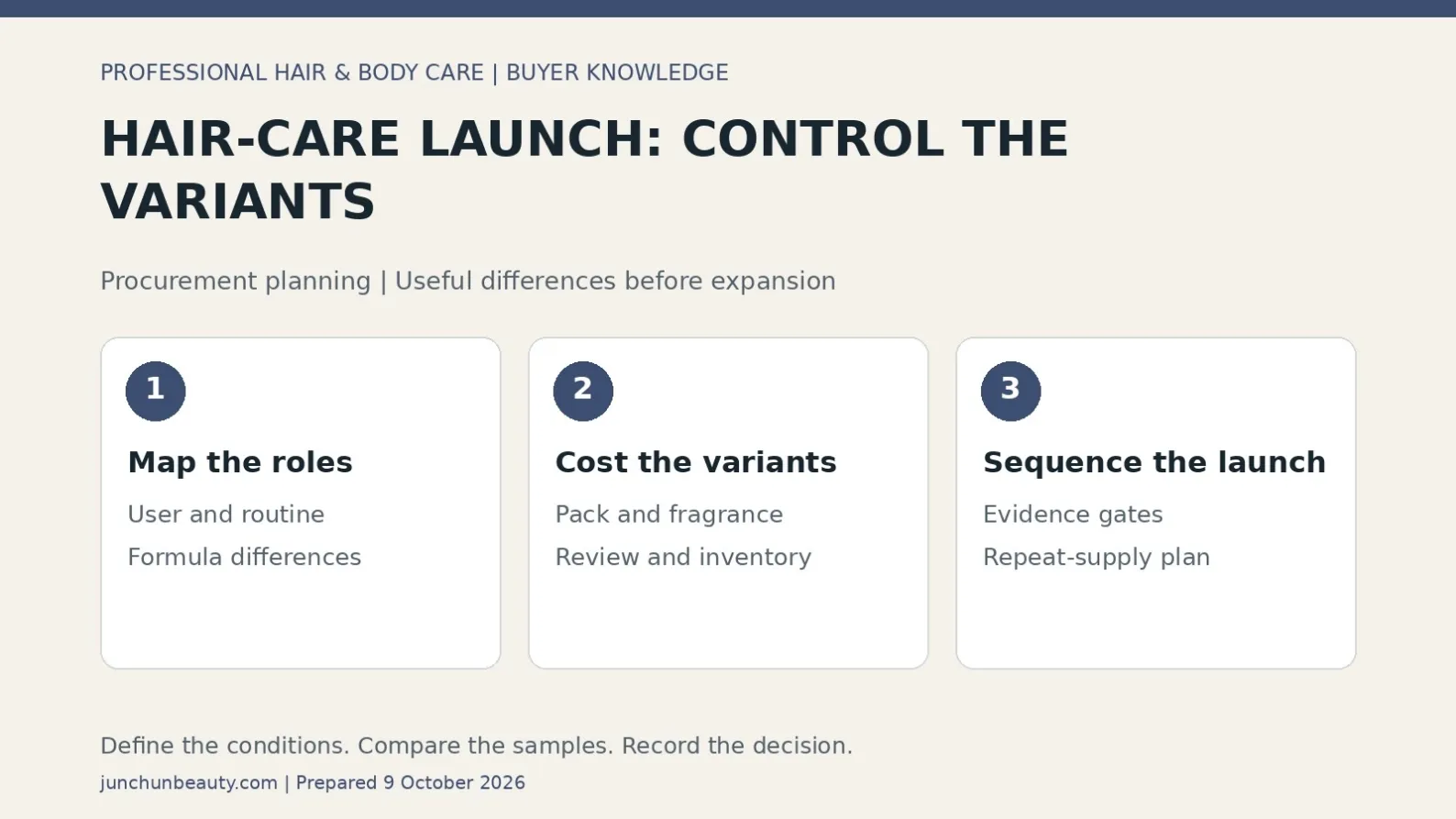
Start with distinct customer and routine roles, then itemize the work created by each formula, fragrance and pack variant. Compare a focused launch with a broader range using sample evidence, quoted development scope and inventory exposure. Shared design does not make every SKU technically interchangeable, and fewer products are not automatically the right choice for every distributor.
Use the current signal as a question, not a forecast
On 7 October 2026, Beautyworld’s industry insight discussed simpler routines and multifunctional beauty. Amazon’s promotion page, checked on 9 October, listed hair-care sets. These signals justify reviewing range structure, not assuming a universal preference or sales increase.
A distributor may need separate wash, conditioning and styling steps to serve a professional channel. A young brand may need a narrower pilot. Compare the actual customer tasks and support requirements before deciding that a large collection looks more credible or that one hero SKU is sufficient.
Separate formula, fragrance and pack variation
Create a product matrix with rows for each proposed SKU and columns for formula, scent, size, component, directions and target user. Mark what is shared and what is different. Do not treat a common collection name as proof that the technical work is shared.
A second pack size might use the same formula but require new dispensing and transport assessment. A second fragrance may require compatibility and sensory review. A genuinely different formula can need its own specifications and evidence. Ask the supplier which work can be reused and which remains product-specific.
Compare launch scenarios on an equivalent scope
| Scenario | Potential benefit | Question before approval |
|---|---|---|
| Focused core range | Simpler training and concentrated sampling | Does it leave an important routine need unresolved? |
| Extra fragrance variants | More targeted sensory choices | Is demand demonstrated and each formula-pack route reviewed? |
| Retail and salon sizes | Different channel applications | Are dispensing, stock and reorder requirements defined? |
| Multiple formula routes | More specific user fit | Can the team fund separate evidence and support? |
Quote the cost of complexity explicitly
Request itemized prices for filled products, packaging, decoration, cartons, sampling and agreed technical work. Identify whether minimums apply per formula, scent, component or SKU. Ask about unused packaging commitments and reorder quantities. A small difference in unit price can conceal a larger difference in committed inventory.
Model the inventory at the proposed quantities and use realistic assumptions for stock turn, returns and replenishment. These are your planning assumptions, not industry averages. Do not assign a fixed sales uplift to adding another variant. Include a slower-demand scenario so the team can see the cash exposure before committing.
Make sample evidence a gate for adding a variant
An additional item should solve a documented need or serve a defined channel. Compare filled samples against that role. If the only difference is fragrance, ask whether buyers understand and value the distinction. If the role is a richer conditioner, evaluate dose and rinse behavior rather than approving it because the label looks coordinated.
Record the criteria that would justify moving from pilot to broader supply. These might include repeat orders, manageable support questions and technical approval of the configuration. Enquiries and creator views can inform a shortlist, but they should not be counted as confirmed demand.
Plan repeat supply before approving the first collection
Confirm component availability, formula identification, change-control responsibilities and reorder scope. Record what happens if a stock bottle is unavailable. Agree how substitutions will be reviewed and communicated. A collection that can be repeated with clear references is easier to support than one assembled from undocumented sample changes.
The decision can be a phased launch: approve the core roles first and keep other variants as options pending evidence. Alternatively, a channel with established demand may justify a wider initial range. The procurement aim is to make each added commitment explainable, technically supportable and commercially manageable, rather than to maximize the count of product names.
Buyer FAQ
Does a shared fragrance make different products one technical SKU?
No. Each formula and pack has its own scope. Ask which records can be shared and which checks remain product-specific.
Should every hair-care brand launch fewer products?
No. A focused range is one scenario. Professional channels or distinct user groups may justify additional roles when supported by evidence.
Can retail and salon bottles use the same formula?
They may, but dispensing, handling and packaging requirements still need review. Confirm the exact configuration for each size.
What evidence is better than social views for approving another variant?
Defined user needs, suitable sample results, repeat orders and viable replenishment economics. Views alone do not establish purchase or reorder intent.
Related product routes and project contact
Use the catalogue to map roles and the development routes to compare existing, modified and new formulas on an equivalent scope.
Contact the Junchun OEM/ODM team: Share your proposed product matrix, channels, markets, quantity by SKU, budget constraints and expected reorder pattern.