Hair Perfume OEM: Compare Alcohol-Free and Low-Alcohol Samples
Compare hair perfume OEM carrier options in matched spray packs, measuring dry-down, scent, residue and hair feel before approving a formulation route.
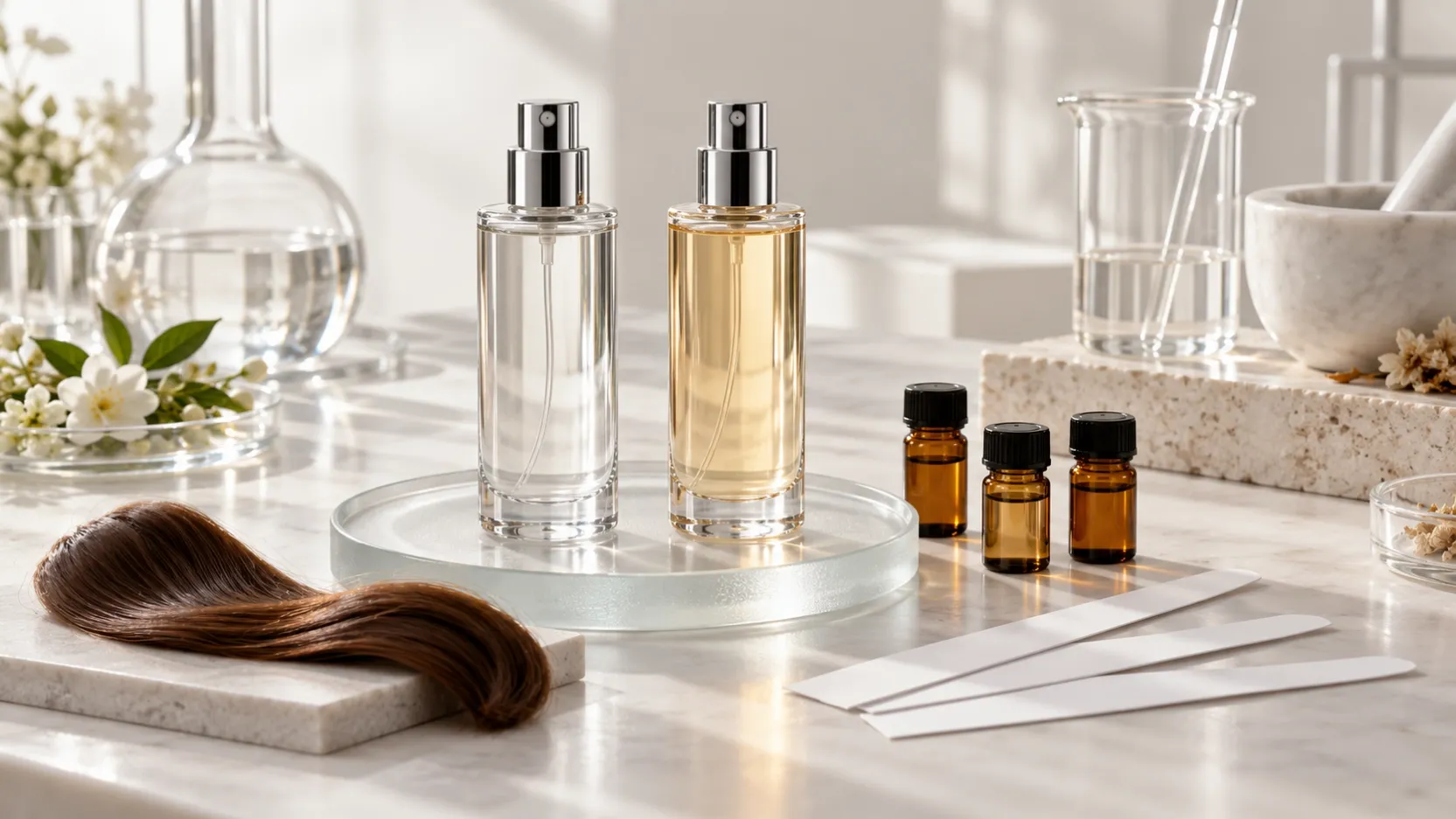
Choose a hair-perfume carrier by comparing feasible finished formulas at matched delivered doses in equivalent packs. Score scent, drying time, residue and hair feel separately. Neither “alcohol-free” nor “low-alcohol” predicts the overall result on its own.
Two recent fragrance signals
Cécred introduced Temple Oud Hair Perfume on 10 September 2026 (release). Soapbox announced alcohol-free hair fragrance finishing mists on 2 September (release). Reviewed 3 October, these are separate brand examples. They do not provide a controlled comparison of carrier systems.
Buyer inference: fragrance-led hair products merit carrier screening when a brand wants a specific drying and after-feel profile. The preferred route remains an experimental question.
Define what “low-alcohol” means in your brief
State the ingredient identity and proposed concentration range with the formulator. A vague marketing term is insufficient for development or artwork review. Also distinguish ethanol-type solvents from ingredients with “alcohol” in their names that serve different formulation functions.
The purchasing decision should cover the whole composition, fragrance load, delivery and intended application zone. Avoid a blanket claim that every alcohol-containing formula damages hair or that every alcohol-free formula is suitable for every user.
Request feasible candidates
Ask for an alcohol-free candidate and a lower-alcohol candidate only if both are feasible for the fragrance and benefit brief. Their supporting ingredients may differ. A fair comparison means similar use conditions, not forcing a formulator to make chemically identical bases.
A matched-pack comparison
- Use equivalent pumps and measure the actual delivered mass. Record any change in spray pattern with each formula.
- Apply coded samples to matched prepared hair at the proposed use dose and distance.
- Record drying time under the same environment and a predefined dry-touch assessment.
- Score initial scent and later scent character independently from hair tack, comb drag, movement and visible residue.
- Repeat the intended application pattern to check whether the acceptable first use remains acceptable.
This is a proposed screen. A claim about drying time or fragrance duration needs a suitable study with defined methods and conditions.
Include the intended audience
If the product is marketed for fine hair, prioritize fine-hair performance. Include other textures only when the claim covers them. Record whether testing is on dry lengths, damp lengths or roots; do not combine those results into an unexplained average.
Compare the broader supply requirements
Ask the supplier to identify stability work, microbiological assessment where relevant, fragrance-use documentation and final-pack compatibility. Have the responsible team establish handling and transport requirements for the actual composition and destination.
A faster-drying sample might introduce different operational requirements. A slower-drying sample might still win if its finish and fragrance acceptance better match the customer. Make the tradeoff explicit.
Approve one route with a written rationale
Set minimum acceptance scores before unblinding samples. Document the winning use condition, delivered dose, fragrance version and claims that remain unproven. Freeze the formula and pack version used for the next validation stage.
FAQ
Is alcohol-free automatically better for hair feel?
No. Test the finished product at the intended dose.
Should both candidates contain the same supporting ingredients?
Not necessarily. Each must be a feasible formulation; compare their intended-use performance fairly.
Can scent duration be judged from blotters alone?
No. A claim about wear on hair requires evidence relevant to hair and the proposed use.
Relevant products and contact
Review the bi-phase hair perfume and shine mist as a fragrance-led development route and OEM/ODM solutions for project scoping. Confirm whether a single-phase or bi-phase route fits the brief.
Contact Junchun Beauty with your fragrance reference, target hair types, application zone, pack and quantity. Request a carrier comparison with dose and sensory acceptance criteria.