Scalp Foam OEM Development: Evaluate Collapse Behavior and Final-Pack Compatibility
Develop a scalp foam OEM brief around collapse behavior, dispensing and final-pack compatibility. Separate visual transformation from supported cosmetic claims.
Direct answer
A scalp foam OEM project should specify what the foam must do during dispensing, placement and spreading, then evaluate the final formula with its intended dispenser. Foam collapse is a usability characteristic, not proof of penetration or efficacy. Treat product stability, microbiological assurance, safety and claim substantiation as separate release requirements.
Why the concept is worth screening
Dyson’s official scalp-care page shows a commercial foam-to-serum format Dyson official scalp bubble treatment (Accessed 10 October 2026; page publication date not stated). It establishes that the format is present in the market, not that every buyer needs it or that any OEM can reproduce it. The purchasing opportunity is to evaluate an original routine benefit, with a feasible dispenser and appropriate technical assessment.
Our development inference is that an observable transition can help users understand an application step. That benefit exists only if the product also handles well after the bubbles disappear. A short video cannot show compatibility over storage or the experience through repeated use. Avoid building the brief around visual novelty alone.
Write an observable behavior specification
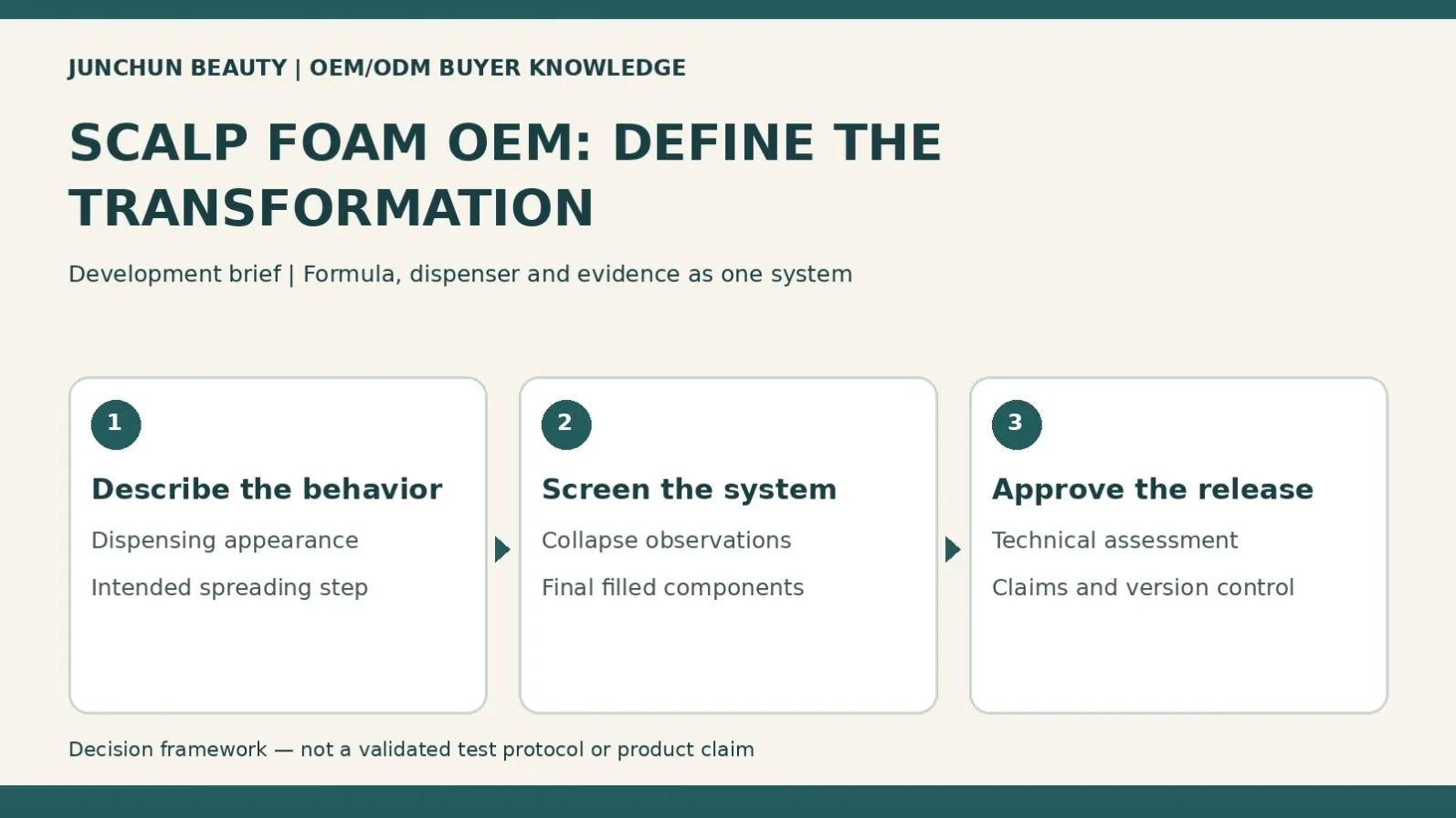
Define the appearance at dispensing, the intended placement area and the spreading action. Ask the technical team whether the target behavior is feasible in the planned format. Replace vague requests such as “luxury bubbles” with observable descriptions, while leaving acceptance limits to a suitable development and evaluation plan.
Record whether the user should spread the foam immediately or after a planned interval, and how much handling is expected. Do not select a collapse time merely because another brand’s clip looks attractive. The desired transition should serve the routine and proposed directions. A more persistent foam may be an inconvenience in one use case and useful in another.
Evaluate representative samples rather than an open beaker
Ask the supplier to screen the actual filled dispenser, closure and product version. Record sample age, storage condition, actuation sequence and observable delivery. Foam seen from a laboratory mixing step may not represent the output of the chosen component. If the package changes, document the change and reassess the affected observations.
Compare the initial dispense with subsequent planned checkpoints, including relevant restart conditions. Note irregular output, liquid leakage, clogging, unexpected changes in foam character or incomplete recovery. These are screening observations for technical review. They do not become evidence of shelf life or transport suitability without an appropriate assessment.
Keep format observations separate from cosmetic claims
Appearance, spread and disappearance should be reported as distinct observations. None establishes that ingredients penetrate more deeply or produce stronger benefits. If the project proposes hydration, oil-control or other cosmetic claims, the final formula needs an appropriate substantiation plan with the target population and conditions defined.
Do not copy clinical percentages, ingredient blend names or medical language from the reference product. A familiar ingredient list does not establish equivalent product performance. Use the competitor to identify an application question, then develop an original product brief and decide claim scope through relevant technical and market review.
Prepare the technical handover and commercial quote
Request the full formula identity and INCI, component references, intended directions, test plan and approval responsibilities. Confirm filling suitability, microbiological assurance, stability and compatibility requirements with the technical team. Avoid treating a well-performing first sample as permission to omit those activities.
Ask whether the route uses an existing validated formula and available components or needs new development. A stock liquid scalp serum may provide a useful lower-complexity alternative. Compare its routine value with the foam proposal. Development fees, special pumps and different filling requirements can change MOQ and lead time; confirm them for the project.
Approve an original solution with controlled changes
Keep a versioned record of the formula, fragrance, dispenser, fill and application instructions. Obtain approval of the final configuration and agree what happens if a component supplier changes. The commercial order should reference that configuration rather than only the product concept name.
The project should advance when its handling advantage is meaningful and its technical pathway is clear. If the transition is inconsistent or the pack creates unresolved risks, revise the brief or compare another format. The goal is a useful cosmetic product with documented release requirements, not an imitation of a visually popular demonstration.
Sources and evidence limits
- Dyson official scalp bubble treatment — Accessed 10 October 2026; page publication date not stated. Evidence of an existing foam-to-serum format, not proof for an OEM formula.
Buyer FAQ
Does foam collapse prove skin penetration?
No. It describes a physical handling observation. Penetration and performance require different evidence.
Can the same formula work in every foam dispenser?
Do not assume so. Evaluate the exact filled formula, component and use instructions together.
Can competitor clinical results support an OEM version?
No. Substantiate claims for your approved finished product; do not borrow another product’s testing or proprietary blend identity.
Is scalp foam an existing 100-piece stock offer?
Availability is unconfirmed. Ask whether the specific formula and components qualify or require separately quoted development.
Related product routes and project contact
- Review the current niacinamide scalp serum route
- Review OEM/ODM development solutions
- Browse professional hair and body product routes
Contact the Junchun OEM/ODM team: Provide the intended scalp routine, transition behavior, application instructions, market, component preference and volume for a foam-format feasibility review. Business email: info@junchunbeauty.com.