Oil-in-Serum Hair Treatment OEM: Choose the Formula Architecture Before the Bottle
Compare oil-in-serum hair treatment OEM routes by formula architecture, stability, dispensing and hair feel before selecting the bottle and claims.
Direct answer
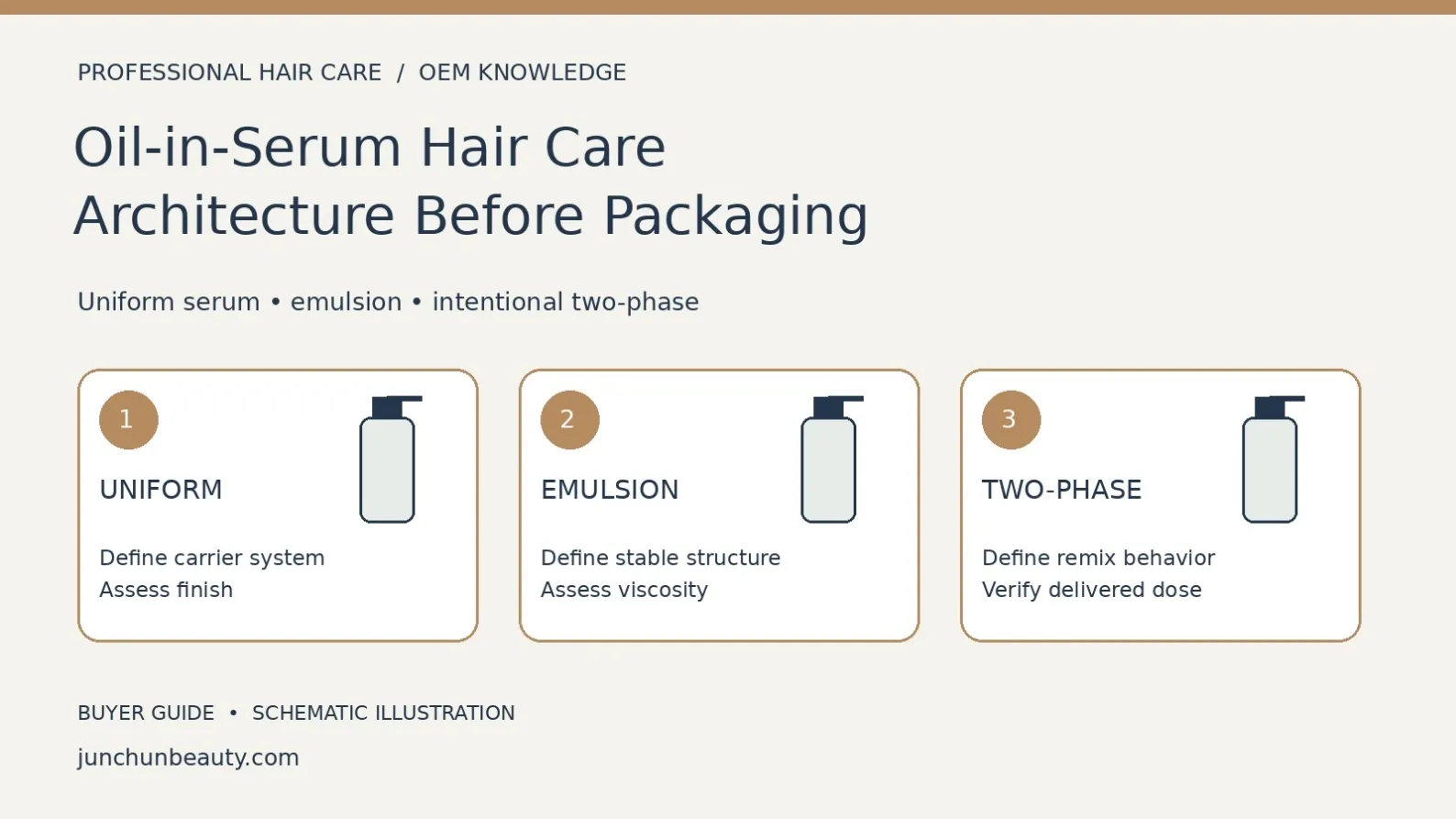
“Oil-in-serum” is a product description, not a complete formulation specification. Before choosing a bottle, decide whether you need an oil-led uniform serum, a water-containing emulsion or an intentional two-phase product. Compare sensory performance, physical stability, microbiological assessment and dispensing in the final pack. A visual effect or ingredient trend should not determine the architecture on its own.
Why the name needs a technical brief
Recent strand-care launches combine oil and serum language with targeted performance stories. Nutrafol's 30 September announcement is one example; it does not establish that all hybrid serums have the same structure or benefits. Source: Nutrafol release, 30 September 2026.
Formulation suppliers also publish distinct serum and two-phase examples. Lubrizol's Defrizzer Juice example is an emulsion, while its Perfect Liss example is designed to mix before use. These illustrate separate development routes, not ready-made claims for a Junchun product. Sources: Lubrizol serum formulation and two-phase formulation, accessed 5 October 2026; page publication dates not specified.
Compare three architecture choices
| Route | Main development question | Pack implication |
|---|---|---|
| Uniform oil-led serum | Which carrier blend gives the intended spread and finish? | Match viscosity, output and material compatibility |
| Water-containing emulsion | Can the selected structure remain consistent through storage and use? | Confirm pumpability and dispensing after storage |
| Intentional two-phase product | Can normal shaking produce consistent delivery? | Leave mixing space and verify output after agitation |
A clear water-led system with solubilized materials is another possible route. Ask the chemist whether it is technically appropriate for the intended oil load and performance. Appearance alone cannot identify the architecture.
Uniform does not mean universally suitable
Specify oil, ester or silicone preferences as constraints for review, not performance conclusions. A silicone-free requirement may be commercially relevant to a target audience, but it does not automatically mean lower weight or better manageability.
Compare the finished samples at a controlled dose on the intended hair condition. Do not select the route solely from a raw-material marketing sheet.
Define “lightweight” with observations
Write what buyers should see or feel: distribution, movement, shine, tack, coated feel and reapplication behavior. Give each observation an agreed scale or descriptive acceptance target.
Assess fine hair separately if loss of body is important. Include relevant textured or processed hair if the product is intended for those users. A favorable result on one group should not become “suitable for all hair types.”
Review stability according to architecture
Ask R&D for a project-specific stability plan covering appearance, odor, color, viscosity and other relevant specifications. Review physical and chemical risks separately.
For an emulsion, record changes such as separation or viscosity drift against agreed limits. For an intentional two-phase product, separation at rest may be expected; the key question is repeatable remixing and delivery. Do not call uncontrolled separation an attractive bi-phase design after development has failed.
Have the safety and microbiology specialists determine appropriate preservation assessment. “Anhydrous” should not be used as an automatic exemption from a finished-product safety review.
Test formula and dispenser together
Use the intended pump, bottle and fill. Check priming, output variability, recovery, closure leakage and product left at the end of use. Review gasket and material compatibility through the agreed storage and transport program.
For a two-phase product, define a consumer-realistic shaking instruction and a practical delay before dispensing. Assess whether the first and later doses meet the laboratory's uniformity criteria. A beaker sample cannot answer this pack-level question.
Quote the route before approving artwork
A mature uniform serum and a customized two-phase system can have different development costs, timelines and MOQ. Selected mature formulas with stock bottles may support 100-piece orders; exact availability must be confirmed.
Review the hair-care range and fruity collection for portfolio roles. Keep claims such as heat protection, quantified breakage reduction and long-duration frizz control separate from general formula selection.
Buyer FAQ
Is oil-in-serum always a two-phase product?
No. The term can describe different architectures. Request a technical explanation of the proposed base.
Can a clear bottle prove stability?
No. It helps observation but does not replace a defined test program.
Does silicone-free guarantee a non-greasy finish?
No. Test the actual formula at realistic doses.
Can I change the architecture without changing MOQ?
Not necessarily. Raw materials, batch requirements, testing and components may change.
Project discussion
Send your target hair type, application area, desired finish, ingredient constraints, pack reference, markets and quantity through Contact. Request an architecture recommendation before committing to a bottle.