Oct 27, 2026Buying Guides
Heat and Humidity Care OEM: Separate the Two Test Questions
Brief heat-care and humidity-care evaluations separately, with defined samples, controls, use conditions and evidence for proposed leave-in claims.
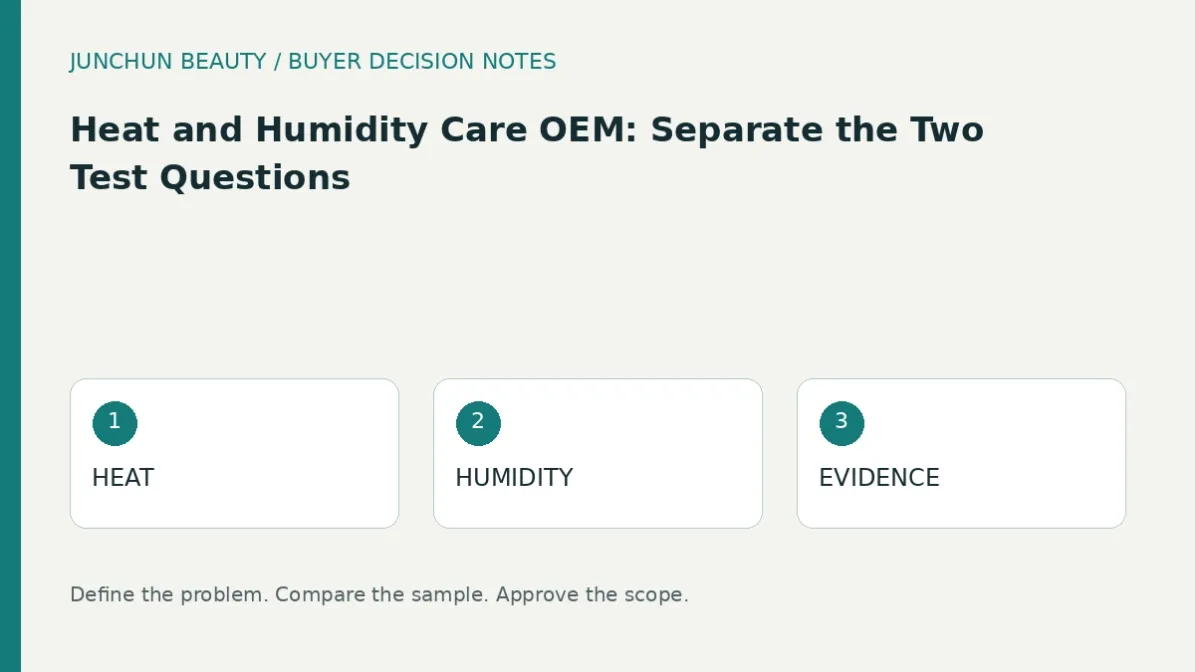
Evaluate heat-care and humidity-care claims separately. A sample that looks smooth after styling does not by itself establish a protection temperature or resistance under a defined humidity challenge.
Define the proposed wording first
Write the exact proposed label statement and the user conditions it implies. Separate a general conditioning description from a temperature number, a duration and a comparison with untreated hair. The sample code, revision and directions should be fixed before commissioning work. Do not place a numerical promise on the label and ask the laboratory to find a convenient method afterwards.
Brief the thermal evaluation
Ask the evaluator to define substrate, pretreatment, application mass, drying, tool temperature, exposure and repeat cycles. Request appropriate controls and the endpoint that will be measured. Tool setting and actual exposure are not interchangeable details. This is a proposed briefing framework, not a standardized protocol or a report for the current product. The qualified evaluator should choose and justify the method.
Brief the humidity evaluation separately
Specify the target hair types, styling method, environmental conditions and observation times. Record both visible frizz and unwanted loss of movement or volume. A high-hold film that preserves shape may not suit a soft-finish salon brief. Compare repeat-use residue and normal washout alongside the chosen performance endpoint so the buyer can assess the whole routine.
Tie evidence to the commercial specification
Ask JunChun to review the 200 ml heat-and-humidity leave-in route against the buyer’s intended claims. Quote the approved formula and component, then list any report, artwork or packaging changes separately. Retail promotion of hair care supports watching the category, but it provides no performance evidence for this formula. Approval should follow the sample and report, not the popularity of a heat-protection keyword.
Buyer FAQ
Can one smoothness photograph support 230°C?
No. A specific temperature statement needs relevant product-specific evidence.
Does humidity performance establish heat protection?
No. They are different evaluation questions.
Are these test results?
No. These are proposed questions for a qualified evaluator and the selected project.
Discuss your formula and packaging brief
Selected mature formulas with eligible in-stock packaging may start at 100 pcs per SKU. Packaging changes start at 500 pcs per SKU, subject to component and decoration process. Send your target market, customer problem, pack size, quantity and preferred formula route to info@junchunbeauty.com for a sample and quotation review. Formula availability, project documents and any additional testing are confirmed for the exact order.
Review the 200 ml leave-in: https://www.junchunbeauty.com/products/private-label-heat-humidity-care-leave-in-200ml-oem
Compare multi-benefit leave-in formats: https://www.junchunbeauty.com/products/private-label-multi-benefit-leave-in-conditioner
Sources and evidence boundaries
Evaluation steps are editorial proposals, not test results or universal standards. Brand examples do not establish JunChun equivalence.
Retail hair-care attention checked 27 October 2026; no performance inference: https://www.aboutamazon.com/news/retail/amazon-holiday-beauty-event-2026