Hair-Care OEM for Promotional Channels: Build a Margin and Returns Gate
Build a hair-care OEM promotion brief around contribution margin, returns reasons, stock availability and a documented reorder gate before scaling.
Direct answer
A promotion-ready hair-care OEM project needs a documented margin model, clear return diagnostics and a feasible reorder path before the brand increases volume. Compare quotations on the same scope, model the effective selling price after deductions, and define what product or packaging failure would stop expansion. Promotional reach alone does not justify manufacturing more stock.
The current retail context
Amazon has scheduled Prime Big Deal Days for 6–7 October 2026. Source: Amazon event overview, accessed 6 October 2026. The announcement establishes timing, not completed event sales or a guaranteed demand lift for a new private-label shampoo.
Buyer inference: when shoppers compare offers across established brands, a new OEM range needs both a credible product role and commercial room for acquisition and service costs. The following framework is our procurement recommendation, not an Amazon seller-policy guide or a revenue forecast.
Ask for a quotation you can compare
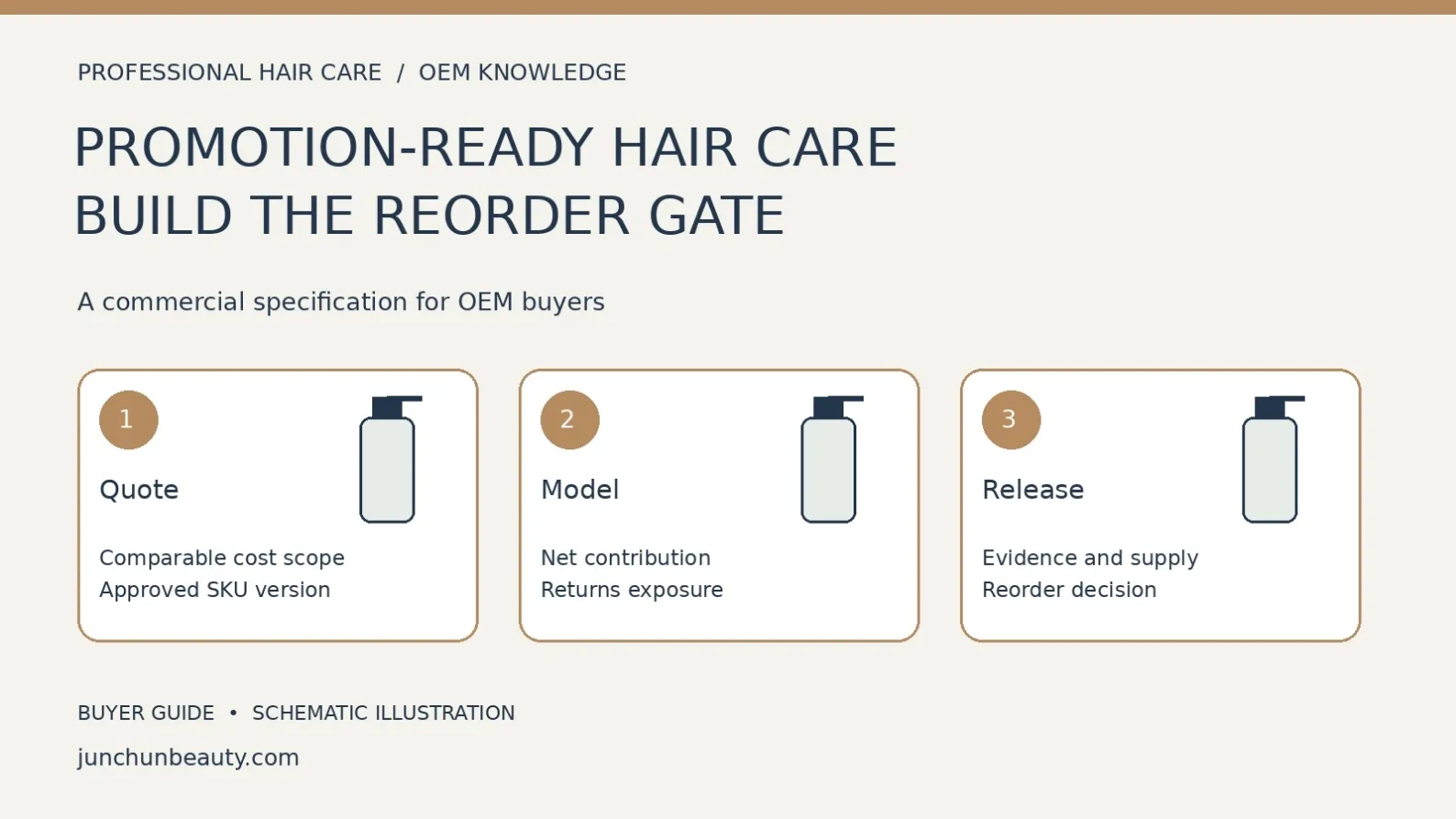
Name the formula version, nominal fill, bottle, closure, decoration, outer packing and quantity per SKU. Separate formula work, component sourcing, evaluation, artwork and logistics. Confirm the trade term and destination assumptions with the quotation.
A headline unit price can exclude important work. Likewise, a bundled offer can hide expensive decoration or a component that is not repeatable. Ask how long the quotation remains valid and what changes require requotation. Do not assume that an initial small-stock route can be scaled indefinitely using the same component availability.
Separate costs by behavior
Variable costs change with shipped units, orders or transactions. Fixed launch costs may include artwork setup or a specific evaluation program. Keep those categories explicit and decide how the launch budget treats each. A contribution calculation and total project profit are different views of the same decision.
Model contribution with a stated denominator
For a simplified first screen, use net sales after discounts and refunds, then deduct the matching product cost, fulfilment, transaction charges, advertising and other variable selling costs. Define the time window and units included. Reconcile returned inventory to avoid counting the same loss twice.
Hypothetical example, not a Junchun quote: if net receipts allocated to one shipped unit are $9.00, and product, fulfilment, selling fees and acquisition cost total $8.20, the remaining contribution is $0.80 before allocated fixed costs. A small change in returns or advertising could remove that margin. Replace every figure with your project data.
| Model input | Ask for or measure | Why it affects procurement |
|---|---|---|
| Effective selling price | Actual discounts and refunds | Limits affordable delivered cost |
| Product and pack cost | Approved specification and trade term | Controls unit-cost comparability |
| Returns exposure | Reason codes and disposition | Identifies formula or pack redesign |
| Acquisition spending | Cost tied to the reviewed cohort | Prevents views being mistaken for profit |
| Replenishment | Component stock and confirmed lead time | Determines how much demand can be served |
Test a base case and less favorable cases. Do not present a single assumed return rate as an industry norm. Record which inputs are measured and which are estimates.
Use returns to diagnose product fit
Separate leaks, pump faults, damaged parcels, fragrance dislike, residue and use confusion. A high return count does not tell the laboratory what to change. Match complaints to the formula and component version shipped, and investigate recurring quality or safety concerns promptly.
Keep technical and commercial decisions connected. If users complain that a leave-in feels heavy, review intended dose and audience as well as the formulation. A price discount cannot correct an unclear role in the routine.
Build the reorder gate before the first campaign
Require the agreed quality checks, acceptable customer experience, workable contribution and confirmed supply to align. Specify who signs off and what information remains missing. Use actual delivery and consumption timing when assessing repeat demand.
Professional formats, custom formulas and special packs are quoted by project. Selected mature formulas in in-stock bottles may offer a lower starting quantity, but the eligibility should be confirmed for each SKU. Review hair-care development options and keep the initial assortment focused.
A buyer should also retain specifications, approved samples and a substitution rule. If the closure changes between the initial campaign and reorder, recheck relevant dispensing, leakage and compatibility rather than treating it as an administrative detail.
Buyer FAQ
Does gross revenue determine the reorder size?
No. Review net contribution, product experience and feasible replenishment together.
Is a supplier's EXW price the landed cost?
No. Add the project's relevant logistics, duties and other costs on a comparable basis.
Can returns all be treated as fragrance dislike?
No. Record reasons and inspect evidence; component faults need a different response.
Does a small launch guarantee the same future stock bottle?
No. Confirm availability and an approved substitution process for repeat orders.
Project discussion
Send the country, channel, product role, quantity, effective selling-price target and packaging scope through Contact. Request a comparable formula-and-pack quotation and a replenishment plan before committing to promotion volume.