Sep 19, 2026Buying Guides
100–500 Unit Hair Care OEM: Stock vs Custom Routes
Choose ready-to-brand, semi-custom or fully custom hair-care OEM routes for a 100–500 unit pilot based on speed, differentiation, testing, MOQ and risk.
Direct answer: For a 100–500 unit hair-care pilot, use a ready-to-brand route when speed and lower commitment matter most, a semi-custom route when the brand needs selected sensory differences, and a fully custom route only when the commercial concept justifies more development time, testing and MOQ. The best route is the smallest one that can prove demand without weakening the brand promise.
A quick route-selection rule
Choose ready-to-brand when the main goal is to test the market, packaging, price and sales channel. Choose semi-custom when fragrance, texture, appearance or one performance direction materially affects the positioning. Choose fully custom when the formula itself is the core intellectual property or competitive advantage.
Do not select a route only from unit price. Include sample iterations, packaging components, testing, artwork, compliance support, launch timing and reorder plan in the decision.
Ready-to-brand: fastest path to a pilot
Ready-to-brand is best for
New brands, salon owners, distributors testing a new category and buyers that need an initial range quickly.
Ready-to-brand keeps these elements standard
The mature formula and stock packaging route remain within approved options. Branding, label artwork and selected pack details create the market identity.
Ready-to-brand commercial advantage
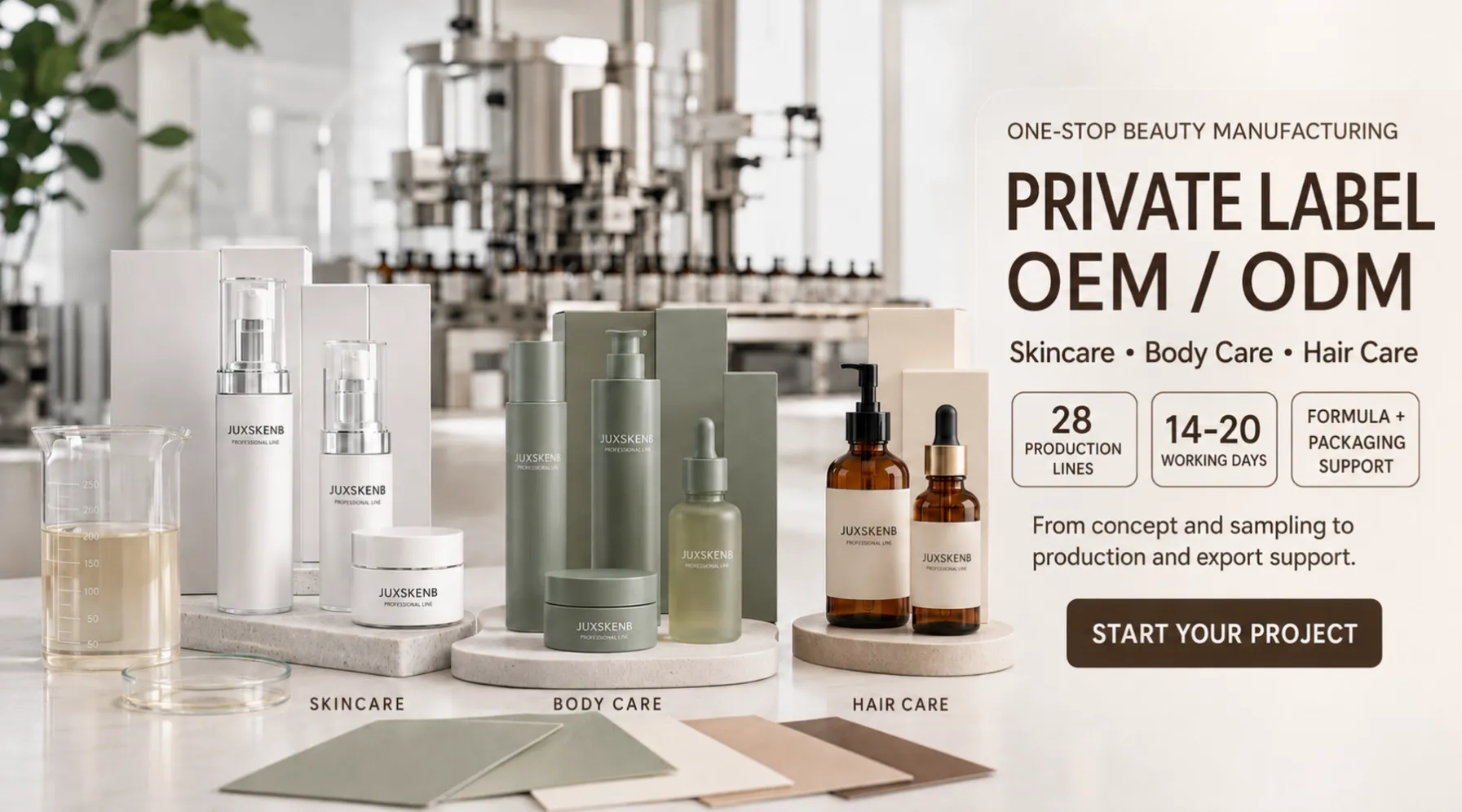
Selected stable formulas using in-stock bottles may start from 100 pieces per SKU. Typical private-label production may be 14–20 working days after formula, packaging, artwork and payment details are approved and materials are ready.
Semi-custom: add differentiation selectively
Semi-custom is best for
Brands that have a clear fragrance, texture, appearance or usage preference but do not need a ground-up formula.
Semi-custom changes to consider
Depending on feasibility, the project may adjust selected sensory characteristics, fragrance, color, viscosity or packaging. Every change can affect compatibility, testing, cost and MOQ, so the brief should rank must-have changes separately from nice-to-have changes.
Semi-custom commercial advantage
Semi-custom can create a more distinctive consumer experience while controlling development risk. It is often the practical middle route for a growing brand with proven channel access.
Fully custom: use when the formula is the strategy
Fully custom is best for
Established brands, funded launches, proprietary ingredient concepts and projects where specific performance or ownership is central to the business model.
Fully custom project requirements
A full brief should cover target market, benchmark, ingredient restrictions, claims, texture, fragrance, pack, target cost, testing and ownership terms. Sample adjustments, scale-up and documentation should be planned before launch timing is promised.
Fully custom commercial reality
Fully custom projects usually require more development time and a larger commercial commitment than a 100-piece stock-formula pilot. MOQ and fees are quoted according to formula complexity, testing, raw materials, packaging and rights.
How 100, 250 and 500 units change the decision
At 100 units, the objective should be learning: validate product acceptance, price and channel. Keep one size, one fragrance and a simple label route.
At 250 units, the brand may support a more polished pack combination or a small coordinated set, but should still avoid too many variants.
At 500 units, there is more room to compare packaging decoration, carton options and selected semi-custom changes. The exact economics depend on the component and formula, not the quantity alone.
What buyers should confirm before paying
Confirm formula route, sample scope, packaging material, decoration method, label or carton responsibility, unit price basis, testing, documents, production lead time, shipment terms and reorder MOQ. Ask which details are included and which are quoted separately.
Common pilot-order mistakes
Launching too many SKUs divides the order and makes sales data weak. Requesting several bottle colors or fragrances increases complexity without proving demand. Choosing a custom formula before defining the target cost can create a sample the market cannot support. A focused hero product plus one logical companion usually produces clearer learning.
FAQ
Can 100 pieces include a completely custom formula?
Usually not under the same conditions as a mature formula with an in-stock bottle. Fully custom formula, color, fragrance and packaging projects are quoted based on the real scope and commercial feasibility.
Is the lowest MOQ always the best option?
No. A very small order may raise unit cost and limit packaging choices. The correct MOQ balances cash risk, target retail price, channel demand and reorder timing.
Can a pilot later move to custom packaging?
Yes. Many brands prove the formula and sales channel first, then upgrade decoration or packaging at the reorder stage when forecast confidence is stronger.
What should be included in the first inquiry?
Send target market, buyer type, product list, quantity per SKU, preferred size, packaging direction, target price and launch timing. Contact: https://www.junchunbeauty.com/contact-us